



Search intent: assess how to run sovereign RAG on a secure, measurable and immersion-cooled GPU platform.
Voltaneum: Operating Sovereign RAG on Immersion-Cooled GPU Cloud
Why this matters in 2026
In 2026, sovereign RAG on Voltaneum GPU cloud is no longer a topic reserved for architects. Executive teams want simple evidence: which services can fail, how long they remain unavailable, which data is exposed, and who decides during the incident. This turns cloud, datacenter and cybersecurity work into one continuity discipline.
Expectations are rising because platforms now host business workflows, critical APIs and AI workloads whose downtime becomes visible immediately. Voltaneum should host the sovereign GPU foundation, Wayhost can run adjacent web services, and ITNET Technologies structures governance, cybersecurity and operations. That connection between providers, operations and governance prevents infrastructure from becoming an opaque utility.
The right reading is practical rather than promotional. A premium platform has to explain how it isolates an anomaly, restores a service, measures capacity and preserves evidence without depending on a single person. That rigor protects production and also protects the commercial relationship when customers ask for verifiable commitments.
The real operating shift
The shift is clear: the issue is no longer only launching a model, but proving where data flows, which sources are queried and how GPU capacity remains available. Teams must connect identity, network, storage, monitoring, backup and cooling into a coherent model. A good architecture only matters if operators can read it and execute it under pressure.
This change forces teams that used to work separately to converge. Security leaders need traces, platform leaders need automation, datacenter owners need controlled physical thresholds, and the business needs predictable service recovery. Shared language becomes an operating asset.
The strongest organizations do not try to make everything complex. They separate decisions: what must be prevented, what must be detected, what must be restored, and what must be documented. That separation makes arbitration faster and investment easier to defend.
Target architecture and responsibilities
A robust target combines source inventory, index isolation, prompt controls, GPU telemetry, network segmentation, access logs, workload queues and immersion cooling that stabilizes capacity. Every component needs an owner, expected evidence and a test procedure. A control that is never checked remains an intention; a backup that is never restored remains a hypothesis.
Responsibility has to be visible in the flows. Secrets must not move through repositories, administrator accounts must be logged, temporary access must expire, and critical environments must be rebuildable from a clean baseline. This frame limits improvised decisions during stressful periods.
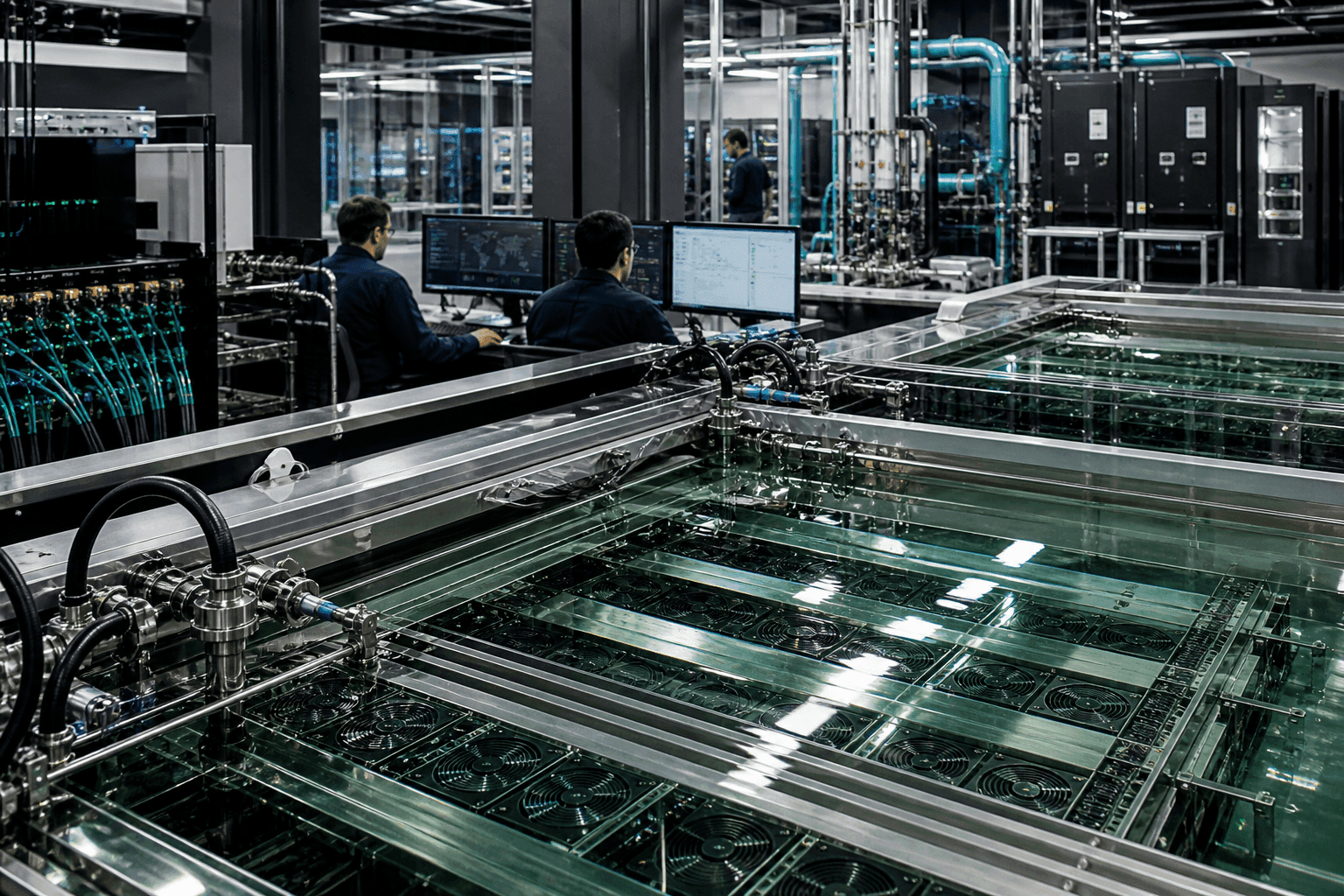
The physical layer matters as much as the software layer. Density, power, fiber, CDU units, manifolds and maintenance choices directly influence application availability. Immersion cooling is a credible answer to density when it is managed as a measurable system rather than a simple energy promise.
90-day action plan
The first thirty days should produce a usable map: assets, dependencies, privileged accounts, outbound flows, backups, contracts, capacity thresholds and existing evidence. The deliverable should fit into a few pages, with gaps ranked by risk rather than technical preference.
From day 31 to day 60, the team should close fast gaps: MFA, access rotation, baseline hardening, recovery tests, log collection, useful alerts and documentation of critical procedures. Decisions should be recorded in a short, dated and reviewable register.
From day 61 to day 90, reality has to be tested. A recovery exercise, network failure simulation or compromise scenario exposes invisible dependencies. The goal is not theatre; it is to measure what breaks, what slows down and what is missing for a clean recovery.
Risks to avoid
The first mistake is deploying a RAG assistant without governing sources, permissions, traces and the real cost of inference. This creates artificial confidence: everything looks ready until the team has to choose between speed, security and evidence. Credible recovery accepts slowing down some actions to avoid repeating the incident.
The second mistake is adding tools without clarifying expected behavior. A dashboard, secret vault, backup solution or orchestrator does not create resilience alone. These tools become useful when their signals trigger precise decisions.
The third mistake is forgetting operator experience. An unreadable procedure will be bypassed, a noisy alert will be ignored, and an exception without an expiry date will become permanent. Operating quality is also measured by the simplicity of daily actions.
KPIs to track
The indicators to track are latency per request, sourced-answer rate, GPU occupancy, retrieval errors, denied access, energy per inference and data incidents. They need to be read together, because one isolated metric can hide a major risk. Excellent availability has less meaning when recovery is never tested or privileged access drifts.
Measurements also have to trigger action. Configuration drift calls for correction, rising latency calls for capacity analysis, a filtration incident calls for maintenance, and a security alert calls for qualification. Without an attached decision, reporting becomes decorative.
Review cadence is decisive. Critical signals need to be inspected at the rhythm of the platform, not only during a quarterly committee. A short, regular and documented review is more useful than a complete report produced too late.
Governance and operations
Governance has to stay close to the field. Access rules, exceptions, alert thresholds, maintenance windows and recovery priorities must be understandable by the people who actually intervene. This avoids policies that are perfect on paper and impractical in production.
A decision register is a simple but powerful tool. It explains why a control exists, which risk it reduces, who approved it, when it will be reviewed and which evidence confirms its effectiveness. Over time, the register becomes the operational memory of the platform.
This discipline also improves customer conversations. A team that can show evidence, limits and an improvement plan earns more trust than a team that promises abstract availability. Premium quality appears in the clarity of commitments.
What matters most
What matters most is simple: sovereign RAG on Voltaneum GPU cloud has to be operated as a living, measured and governed system. Value does not come only from available power, but from using it without losing control of access, data, cost and incidents.
The strongest plans prioritize foundations: identity, backup, logging, segmentation, tests, documentation and useful monitoring. These topics look less spectacular than product announcements, but they determine real service quality when pressure rises.
A robust platform does not eliminate every incident. It reduces the blast radius, accelerates decisions and makes recovery explainable. That ability to prove, correct and improve is what separates genuinely professional infrastructure.
FAQ
What is the first priority for sovereign RAG on Voltaneum GPU cloud? Start by identifying critical services, hard dependencies and the evidence that already exists. Then prioritize controls that reduce risk in a verifiable way.
Should recovery be fully automated from day one? No. Automate first the actions that are repeatable and risky: hardening, log collection, recovery tests, access rotation and useful alerts. Automation should make operations easier to read.
How can a non-technical executive team be convinced? Connect every action to a business risk: downtime, data loss, recovery cost, regulatory exposure or inability to prove a decision. Short evidence is stronger than highly technical argument.
Sources
- NIST Cybersecurity Framework 2.0: https://nvlpubs.nist.gov/nistpubs/CSWP/NIST.CSWP.29.pdf
- CISA Cloud Security Technical Reference Architecture: https://www.cisa.gov/resources-tools/resources/cloud-security-technical-reference-architecture
- Open Compute Project, Cooling Environments: https://www.opencompute.org/wiki/Cooling_Environments