



Search intent: build a trust cloud that can prove cyber resilience, sovereignty and continuity without slowing delivery teams.
Trust cloud: building an evidence chain that operations can use
Why this topic matters now
A trust cloud is no longer a positioning statement. For technology leaders, it is becoming an evidence model: where a workload runs, who can intervene, which backup restores the service, which physical threshold protects capacity and which record remains available after an incident. This pressure grows as AI adoption, regulation and infrastructure density advance together.
Voltaneum is relevant when GPU and sovereign cloud capacity must stay dense and controlled. Wayhost supports governed VPS and hosting services that often sit around critical platforms. ITNET Technologies connects architecture, hardening, operations and proof. The issue is therefore not only technical; it affects customer trust and executive decision making.
The real operating shift
The shift is from a cloud that claims reliability to a cloud that can demonstrate it. A team should not only show average availability; it should prove how it segments, restores, logs and maintains services. NIS2, DORA and NIST CSF 2.0 all push in that direction because they expect explicit dependency and incident management.
This changes trade-offs. A fast migration without an access matrix creates debt. A backup that has never been restored remains an assumption. A dense immersion platform without documented CDU procedures becomes a risk. Evidence turns these blind spots into measurable decisions.
Target architecture and ownership
A robust architecture separates four planes. The compute plane hosts virtual machines, containers, GPUs and application services. The data plane covers storage, classification, encryption and retention. The control plane includes identity, MFA, bastions, secrets, monitoring and consoles. The physical plane tracks immersion tanks, submerged servers, CDU units, manifolds, sensors, fiber and access zones.
Each plane needs an owner, a health indicator, a recovery procedure and an escalation threshold. This prevents an incident from being treated as an isolated failure. It links business impact, platform state, rollback capacity and evidence that can be shared.
Immersion cooling and useful capacity
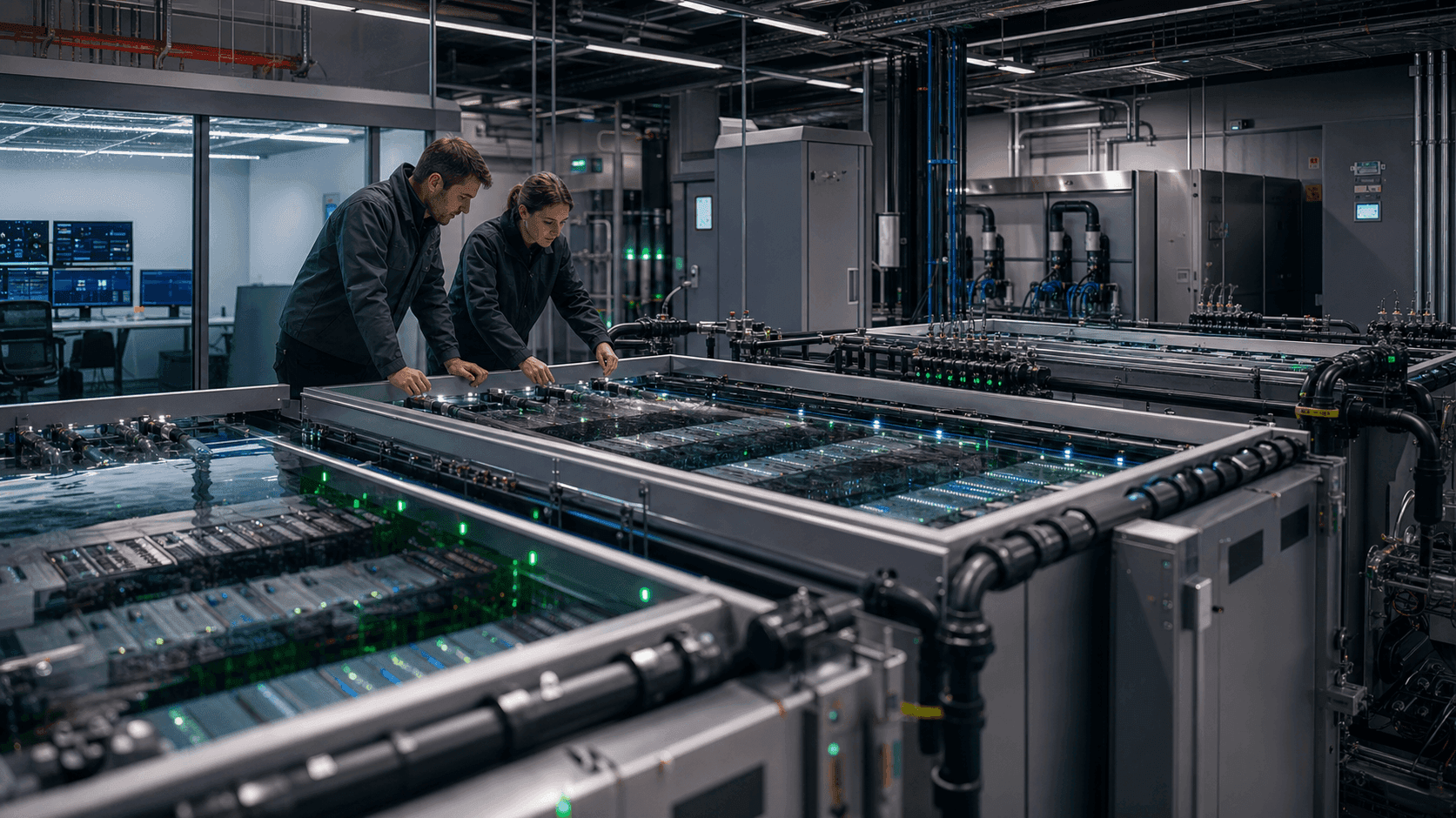
Immersion cooling changes datacenter economics because it concentrates more power in less space. Density is valuable only when it stays operable. Tanks, dielectric fluids, pumps, CDU units, heat exchangers, fittings, sensors and interventions must be tracked with the same rigor as network rules or system images.
The right measure is not installed power. It is useful capacity: what the team can deliver, monitor, isolate and restore under pressure. A critical workload placed without documented thermal margin or a clear recovery path weakens the whole trust chain.
Cloud, VPS and supporting services
Supporting services remain decisive in a trust cloud. Bastions, collectors, probes, repositories, internal portals and backup servers may be less visible than GPU clusters, but they shape recovery. A poorly governed VPS can undermine a premium architecture if it concentrates keys, logs or access without control.
The model should apply core requirements to simple services: controlled images, patch policy, MFA, logging, tested backups and documented revocation. This consistency protects teams without slowing everyday usage.
Practical 90-day plan
The first 30 days should map assets, flows, accounts, backups, dependencies, suppliers, thermal thresholds and procedures. The map must reveal what would be slow to restore, hard to isolate or impossible to explain to a customer. It should also name long-standing exceptions.
From day 30 to day 60, standardize segmentation, bastions, backup, hardening, dashboards, runbooks and placement criteria. From day 60 to day 90, test concrete scenarios: privileged-account loss, full restore, CDU saturation, support VPS outage or capacity change. Each exercise should produce an operational decision.
Mistakes to avoid
The first mistake is confusing power with resilience. A platform can be fast, dense and fragile if access and restores are not tested. The second mistake is treating cooling as separate from cloud architecture. Thermal margin shapes placement, cost, availability and customer commitments.
The third mistake is keeping evidence in an audit folder instead of producing it through daily operations. Useful evidence is dated, understandable and linked to an action: revoked access, successful restore, followed alert, respected CDU threshold or controlled change.
KPIs to follow
Priority indicators include verified restore time, MFA coverage, active segmentation, secret rotation, CDU margin, age of tested backups and availability by service. A useful indicator has an owner, a threshold, an associated procedure and enough history to show improvement.
This avoids decorative metrics. Availability percentage is not enough if nobody knows which component explains the gap. A cyber alert has value only when it leads to isolation, revocation or correction. Value comes from turning signal into decision.
What matters most
A trust cloud connects cloud, datacenter, VPS, immersion cooling, cybersecurity and governance into one model. It does not only promise high availability; it explains how the platform is protected, restored and maintained. That ability to prove becomes a commercial differentiator.
The strongest organizations keep the model simple to explain and precise to operate. They know where data lives, how access is granted, which equipment protects capacity and which record remains after an incident. That discipline turns infrastructure into durable advantage.
Production readiness and continuous governance
Production readiness should be treated as a transfer of responsibility, not as a technical handover only. Before opening the service, the team should verify owners, dependencies, privileged access, backups, alert thresholds, escalation procedures and expected evidence. This review avoids discovering later that a secondary component blocks recovery or that an essential indicator was never collected.
Continuous governance then needs a simple rhythm: monthly risk review, quarterly restore testing, regular access control, analysis of minor incidents and runbook updates after every meaningful change. Decisions should remain short and traceable. An accepted exception needs an end date, an owner and a compensating measure. Without that discipline, platforms accumulate silent tolerances that become expensive when pressure rises.
Financial governance also belongs in the model. Leaders should not compare only hosting price or hardware cost. They should connect truly useful capacity, operating time, energy use, avoided risk, recovery quality and protected business value. This view produces healthier trade-offs, especially when AI, high density and cybersecurity meet in the same budget.
Documentation must remain operational. A long document that nobody reads does not protect the platform. The best teams prefer short runbooks that are tested, versioned and connected to dashboards. They know who decides, what to isolate, what to restore and which message to send. That demanding simplicity is what keeps quality stable over time.
This last step is often where premium infrastructure differs from ordinary infrastructure. The design may be elegant, but the service becomes trustworthy only when evidence is produced repeatedly. Teams should keep proof of restore tests, access reviews, capacity changes, security exceptions, supplier interventions and physical maintenance. These records are not bureaucracy when they help engineers make faster decisions during a real incident. They also make executive reporting more credible because the report is grounded in operating facts rather than optimistic assumptions.
Governance should also include communication rules. During a disruption, technical teams lose time when every stakeholder asks for a different status view. A prepared model defines who receives operational detail, who receives business impact, who speaks to customers and which evidence can be shared. This prevents improvisation and protects engineers from parallel reporting pressure while they restore service. Clear communication is part of resilience because it preserves focus, trust and decision speed.
FAQ
Does a trust cloud require one technology stack?
No. It mainly requires a coherent chain of responsibilities, evidence and procedures across cloud, network, security and datacenter operations.
Why connect immersion cooling and cybersecurity?
Because physical density changes operational risk. Thermal thresholds, access, dependencies and restores need to be governed together.
Which project should start first?
Start with critical services, privileged accounts, restored backups and dependencies that would be hard to explain during an incident.
Sources
- European Commission, NIS2 Directive: https://digital-strategy.ec.europa.eu/en/policies/nis2-directive
- EIOPA, Digital Operational Resilience Act: https://www.eiopa.europa.eu/digital-operational-resilience-act-dora_en
- NIST, Cybersecurity Framework 2.0: https://www.nist.gov/cyberframework
- IEA, Energy and AI: https://www.iea.org/reports/energy-and-ai/energy-demand-from-ai