



Search intent: understand what this immersed server video shows and why immersion cooling changes the way modern datacenters are designed.
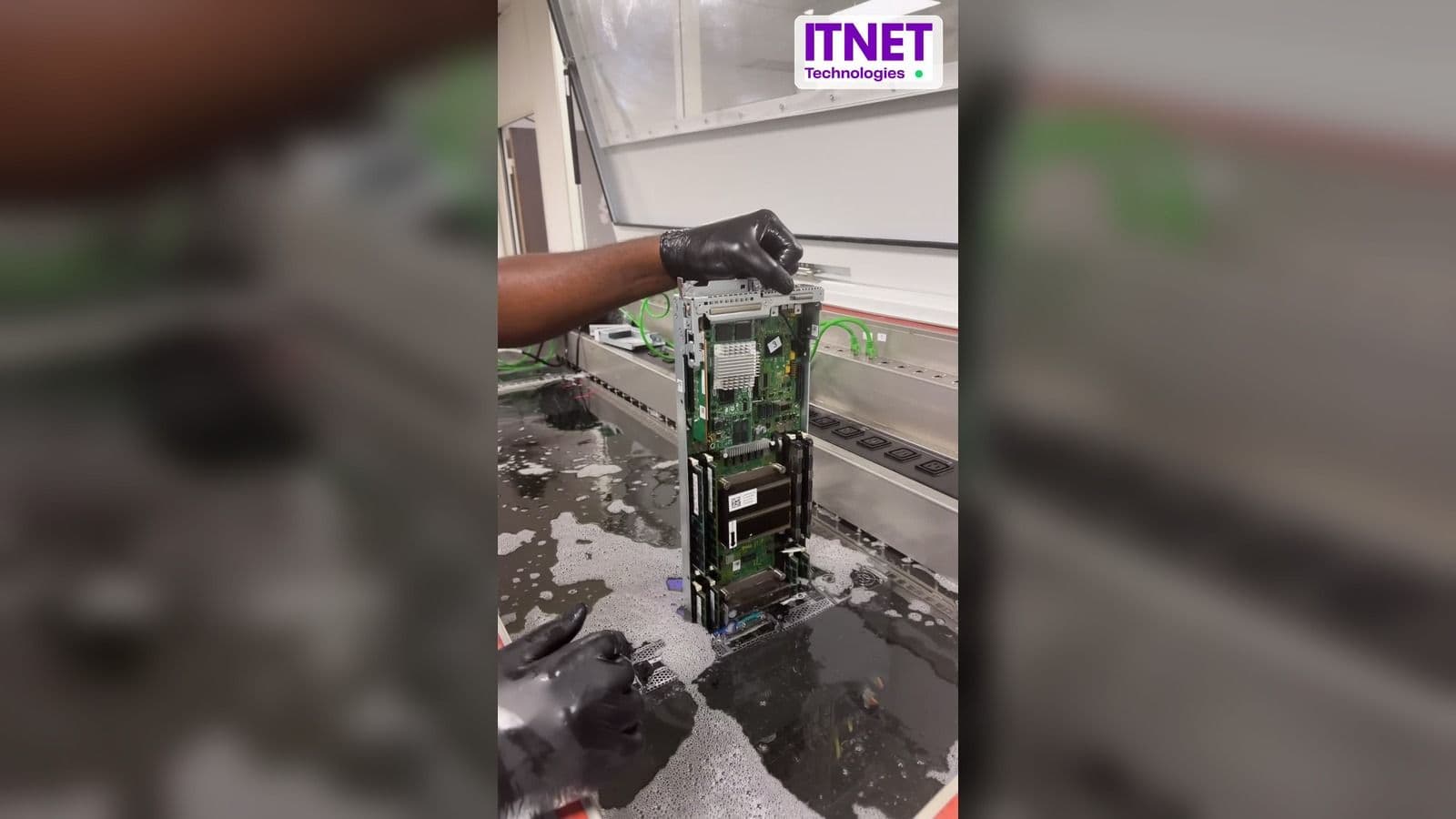
This video shows a server being handled, inspected and re-immersed in an immersion cooling tank. For the reader, the value is not only visual. It makes a datacenter operation tangible: a real server is cooled by direct contact with a non-conductive dielectric fluid instead of relying only on airflow, fans and room-level air conditioning.
In a conventional datacenter, heat is managed through cold aisles, hot aisles, fan speed, room cooling and airflow containment. In this sequence, the logic is different. Cooling moves closer to the source of heat. That shift matters for cloud platforms, VPS infrastructure, GPU clusters, Voltaneum-style high-density architectures and cybersecurity environments that need stable computing capacity.
The immersed server and its visible components
The first point is hardware visibility. The reader can see the server board, heatsinks, connectors and memory zones. The server is not hidden behind a rack front panel. It is a physical system that can be observed, handled and returned to its thermal environment.
This is important because immersion cooling does not remove operations. It changes the operating model. Maintenance is no longer only about airflow, fans and rack grilles. It also involves fluid compatibility, surface control, handling procedures and the ability to bring the server back online cleanly.
Re-immersing the server into the tank
The re-immersion sequence is the clearest moment in the video. The server is lowered into the liquid and repositioned in the tank. The fluid movement makes the technology concrete, while also reminding the reader that this is not water. It is a technical dielectric fluid designed not to conduct electricity and to transport heat.
This distinction matters. A server compatible with immersion cooling cannot be placed into any liquid. The full environment must be designed for it: tank, fluid, cabling, lifting procedures, material compatibility, thermal monitoring and maintenance documentation.
Immersion cooling server maintenance: what to notice
The core search query behind this page is immersion cooling server maintenance. Readers want to know whether an immersed server remains accessible, how it is handled and what this implies for technical teams. The video gives a practical answer: intervention remains possible, but it requires a more precise framework than a conventional air-cooled rack.
The visible gestures matter. The server must be raised or extracted, allowed to drain, kept clean, checked at connector level, documented and re-immersed in a stable position. That discipline protects uptime, electrical safety and component life.
Why cooling is now strategic
Digital demand keeps rising: cloud, backup, AI, cybersecurity analytics, high-performance VPS and GPU workloads. All of these workloads generate heat. As power per server rises, traditional ventilation becomes harder to size and stabilize.
Immersion cooling provides a direct answer by moving heat transfer closer to the hardware. This can support higher useful density, reduce dependence on large air volumes and prepare facilities for more intensive computing loads. That is why high-density infrastructure programs, including Voltaneum-oriented architectures, treat cooling as part of the platform design.
From air-cooled rooms to high-density infrastructure
Air-cooled datacenters remain relevant for many workloads. Immersion cooling is not meant to replace every traditional rack. It becomes relevant when density, thermal efficiency and available power become decisive design criteria.
In this video, the reader sees that transition. The server is no longer only a unit stacked in a cabinet. It is part of a complete thermal system. Tank, fluid, cabling, procedures and monitoring work together. That architecture changes how modern rooms are planned.
Hardware compatibility: cables, power and servers
Compatibility is not limited to the server. It also includes network cables, power cables, seals, plastics, labels, connectors and any part that remains in contact with the fluid. Some materials may swell, soften or contaminate the fluid if they have not been validated.
For network cables, the outer jacket and connector behavior over time must be checked. For power cables, insulation, thermal behavior and material compatibility matter. For servers, teams must validate fans, pads, adhesives, labels, SSDs, capacitors and serviceable parts. A serious policy starts with a compatibility list from the server vendor, the fluid supplier and the integrator.
Practical figures to read the scene
| Observed point | What the video shows | Datacenter impact |
|---|---|---|
| Dielectric fluid | The server is re-immersed in a non-conductive liquid | Cooling happens closer to the components |
| Maintenance | The module remains serviceable | Intervention is possible with dedicated procedures |
| Connectivity | Cables are visible at tank level | Network and power compatibility must be verified |
| Density | Cooling depends less on room airflow | Stronger basis for cloud, GPU, VPS and cybersecurity workloads |
| Visual proof | Real video from a server cabinet | Concrete evidence for understanding the technology |
These figures do not replace thermal engineering, but they help the reader interpret the scene. The image shows an architectural shift: cooling becomes a central part of datacenter design, alongside power, network, storage and security.
FAQ
Is dielectric fluid water?
No. A dielectric fluid is designed not to conduct electricity and to transfer heat. That is what makes it possible to immerse compatible servers without short-circuiting components.
Is maintenance still possible?
Yes, but it follows specific procedures. The server can be handled, inspected and re-immersed if draining, cleanliness, connectivity and intervention documentation are controlled.
Is immersion cooling safe for a datacenter?
Safety depends on the full design: validated fluid, suitable tank, material compatibility, maintenance procedures, supervision and trained teams. The technology must be integrated as a system, not as an accessory.
Are all servers compatible with immersion cooling?
No. Compatibility must be verified for the server, network cables, power cables, connectors, plastic supports, labels and components. An air-cooled server may require adaptations before immersion.
Further reading
Readers who want to connect this video to an infrastructure strategy can explore ITNET Technologies expertise in datacenter architecture, cloud and cybersecurity.
For professional hosting, VPS environments and operational cloud services, Wayhost connects these topics to availability, performance, security and continuity needs.
For high-density infrastructure, GPU cloud and AI-ready architectures, Voltaneum shows why immersion cooling is becoming strategic for next-generation datacenters.
Key takeaway
This video shows a simple reality: the datacenter is changing. An immersed server is not an isolated curiosity. It represents a more direct way to manage heat, prepare high density and support modern cloud, VPS, AI and cybersecurity workloads.
What the reader sees here is visual proof: immersion cooling server maintenance exists, follows precise procedures and changes how digital infrastructure is designed.