


Search intent: know which network cables to use with immersion cooling and how to avoid compatibility, signal and maintenance problems.
Network cables for immersion cooling: what to validate before connecting a tank
In immersion cooling projects, network cables are sometimes treated as a secondary topic. That is a mistake. Networking connects immersed servers to storage, orchestration, backup, observability and the rest of the datacenter. A tank can be thermally excellent and still become fragile if the network layer is poorly qualified.
Readers should treat network cables as production components. In immersion, the question is not limited to advertised bandwidth. Teams must validate jacket material, connectors, transceivers, signal quality, fluid compatibility, labels, bend radius, serviceability and the boundary between immersed and dry zones.
Voltaneum illustrates this need in GPU and AI environments where networking becomes as critical as cooling. Wayhost remains relevant for cloud and VPS services connected to these platforms. ITNET Technologies brings the integration discipline required to prevent cabling from becoming the weak point.
Network Sizing Table
These figures help visualize why cabling matters in a tank. They do not replace vendor specifications, but they prevent underestimating the network layer.
| Cabling scenario | Raw interface capacity | Typical use | Immersion point to validate |
|---|---|---|---|
| 1 server with 2 x 100G | 200 Gb/s | storage, east-west traffic, fast backup | QSFP28 module and jacket compatibility |
| 8 servers with 2 x 100G | 1.6 Tb/s | small GPU or dense cloud cluster | CRC errors and link drops under load |
| 1 server with 2 x 400G | 800 Gb/s | high-bandwidth AI node | OSFP/QSFP112 modules qualified for fluid |
| 16 servers with 2 x 400G | 12.8 Tb/s | dense AI fabric | bend radius, labeling and replacement stock |
| 100G or 400G AOC | active electronics at cable ends | organized short links | temperature, DDMI/CMIS monitoring, fluid validation |
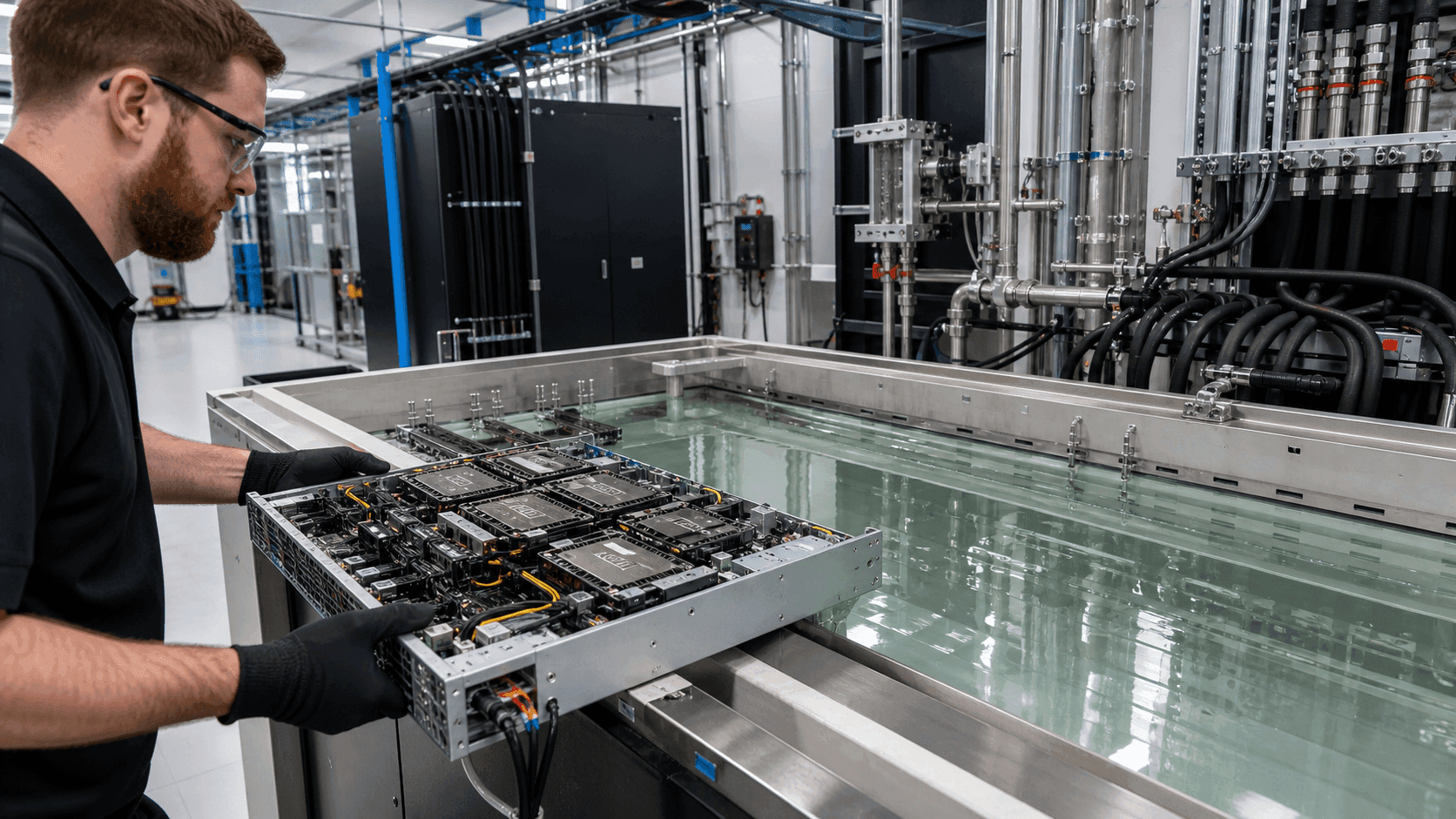
Concrete illustration: if a tank hosts 8 servers with two 100G links each, the theoretical interface capacity reaches 1.6 Tb/s. One unqualified cable family can affect storage, orchestration or inference. Links should be tested before immersion, after immersion and under production-like load for at least 24 to 72 hours.
Why Networking Is More Sensitive In Immersion
A cable designed for a cold aisle is not automatically suitable for an immersion tank. In air, the jacket, connector and optical module operate in a familiar environment. In dielectric fluid, materials face continuous exposure that can affect polymers, adhesives, additives and printed markings.
OCP immersion active optical cable specifications provide a useful principle: products must be compatible with the fluid and maintain performance equal to or better than operation outside the fluid. That changes procurement. The right cable is not only the one that fits the port; it is the one validated for the real operating environment.
Fiber, DAC And AOC Are Different Decisions
Network links may use passive fiber, DAC, AOC, QSFP, OSFP or other formats depending on bandwidth and distance. In immersion, each family creates different constraints.
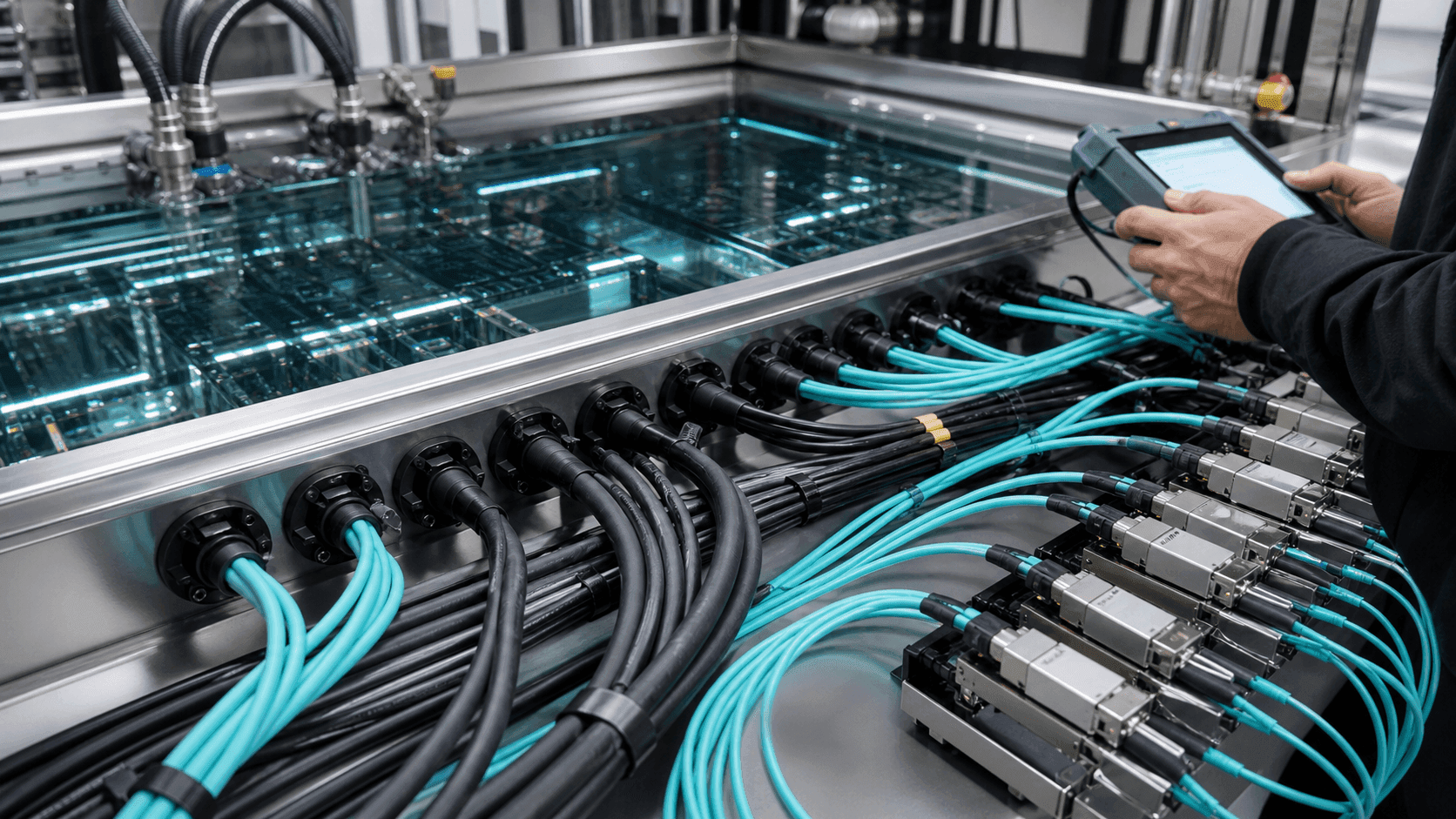
Passive fiber avoids some thermal and electrical questions, but connectors must stay clean, protected and accessible. DAC cables carry electrical signals over copper and require validation of signal integrity, jacket material and connector behavior. AOC assemblies combine optics and electronics; active ends, thermal behavior, fluid compatibility and monitoring become decisive.
At high speeds, assumptions are expensive. Fast signals tolerate little approximation. A module designed for air can behave differently when its surrounding medium changes.
Transceivers And Optical Modules
Transceivers are sensitive because they combine electronics, optics, heat and fine connectors. Recent OCP 100G and 400G immersion specifications reference material compatibility, in-fluid performance and accelerated testing.
Readers should ask whether the module is intended for immersion, which fluid was tested, at what temperature and for how long. They should also check management interfaces, alerts, temperature range, optical power metrics and cleaning procedure. A module that works on day one but drifts after exposure is not acceptable for a critical platform.
In AI clusters, this is central. GPU communication, distributed storage and orchestration can all depend on dense high-speed networking. A poor transceiver choice can constrain an otherwise powerful compute platform.
Jackets, Plastics And Labels
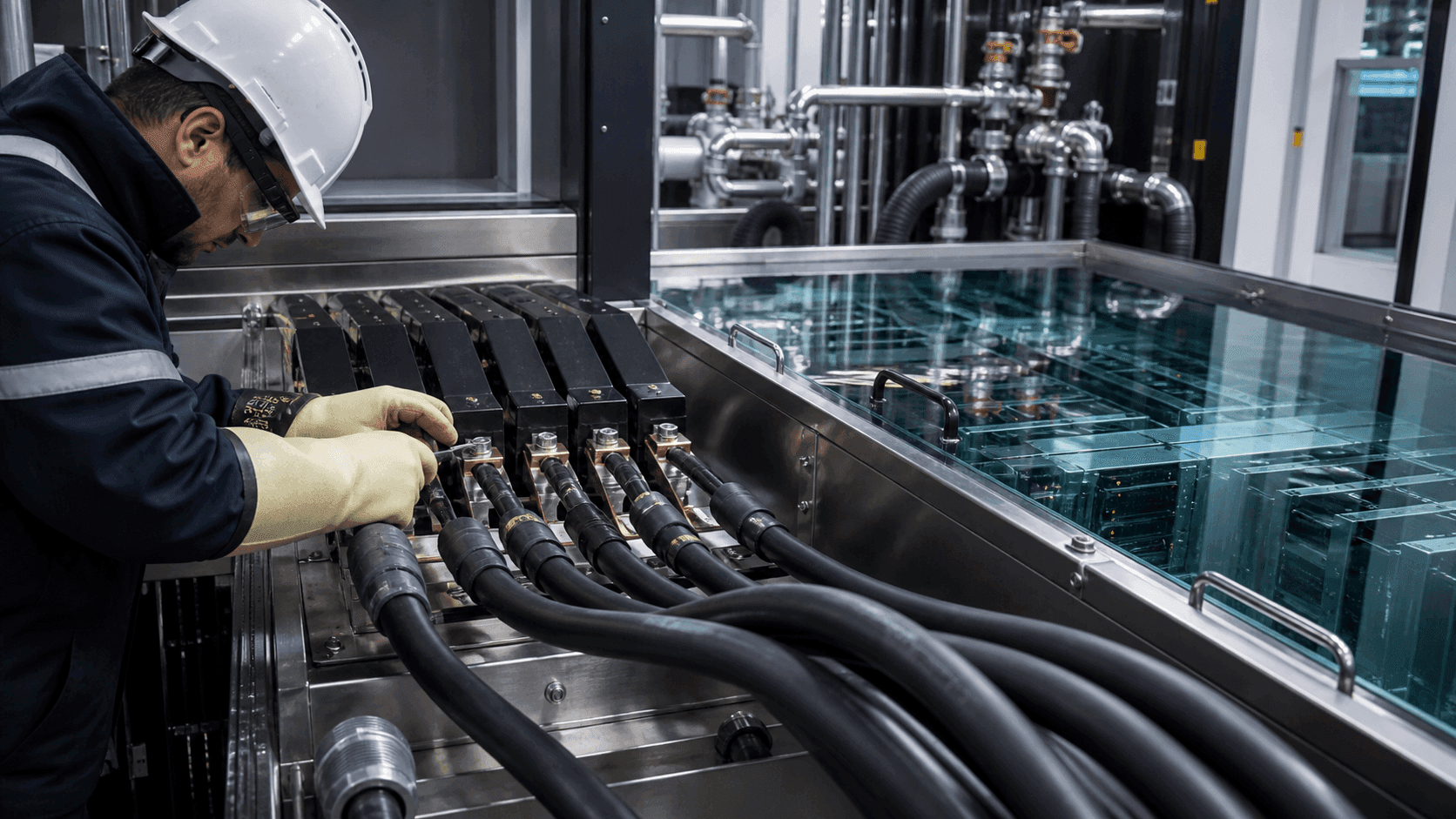
The cable jacket is not a detail. Some polymers can swell, harden, leach additives or lose mechanical properties depending on the fluid. Labels and markings can also detach or become unreadable. This sounds minor until a team must intervene quickly in a tank full of anonymous cables.
Choose cables whose jackets and markings are validated. Labels must resist fluid, handling and time. The cable plan must be understandable from the tank and from the switch side. In high-density infrastructure, maintainability is as valuable as raw bandwidth.
Boundary Between Dry And Immersed Zones
Not every network component belongs in the fluid. A clean architecture defines what is immersed, what exits the tank, what stays dry and what can be replaced without stopping too much service.
This boundary affects cable glands, fiber management, spare length, switch paths and maintenance procedure. The clearer the design, the lower the risk during intervention. Avoid improvised exits, tight bend radii and unnecessary immersion of components that were never qualified.
Signal, Throughput And Monitoring
A material-compatible cable is still a bad choice if network performance is unstable. Teams should monitor CRC errors, link loss, module resets, optical statistics, temperature and alarms.
Tests should run before production and after commissioning. A cluster can look stable at low traffic and fail during AI load, data rebuilds or backup windows. Immersion cooling improves thermal conditions; it does not fix unvalidated networking.
Maintenance And Replacement
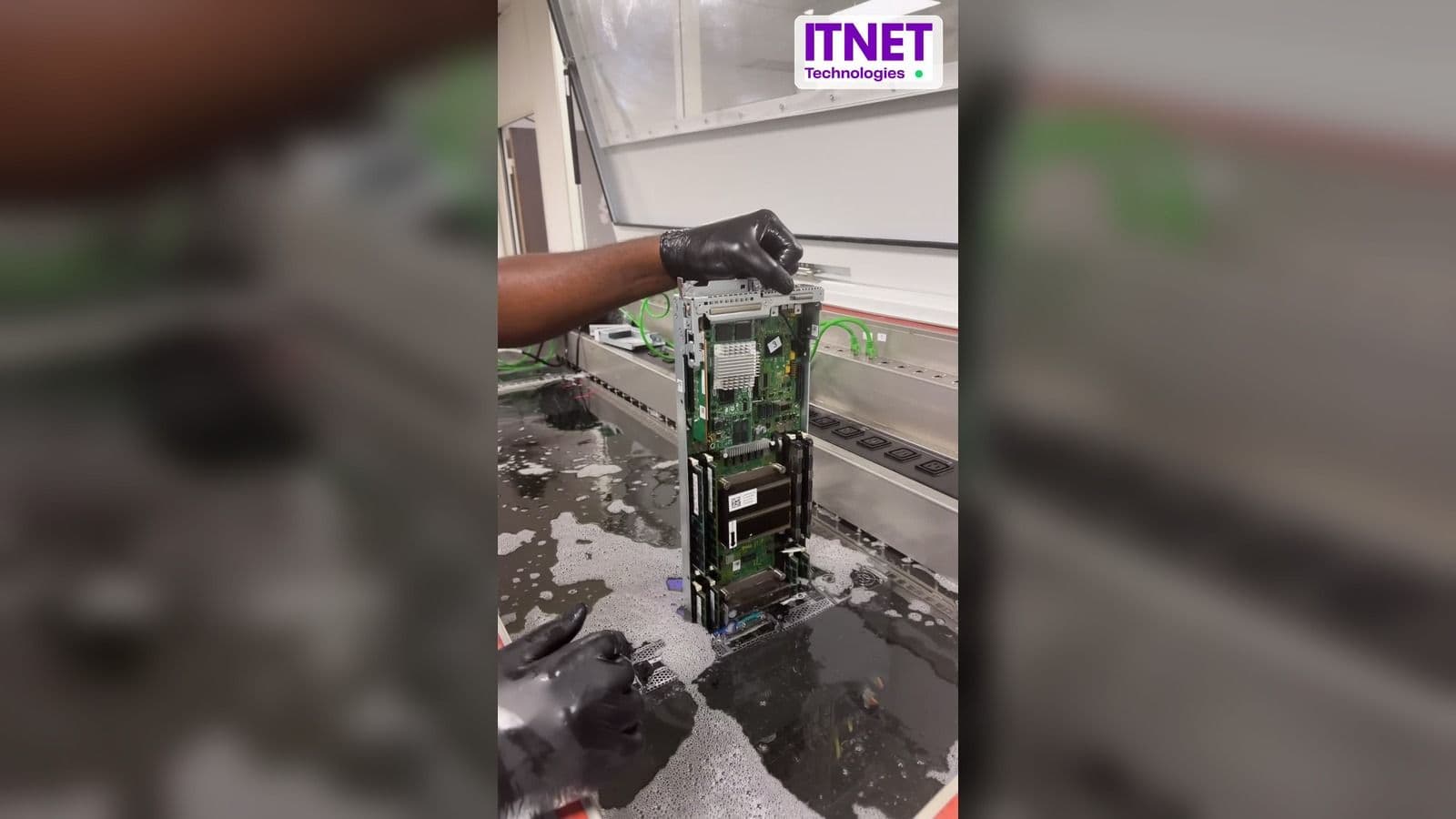
Replacing a cable in immersion requires a procedure. Teams must know how to isolate the link, manipulate the cable, avoid contamination, clean connectors if needed, validate signal restoration and record the change.
Replacement stock must use the same validated references. Swapping in a standard emergency cable introduces hidden risk. In a critical datacenter, troubleshooting should not weaken the initial qualification.
Procurement Checklist
Before buying, ask whether the cable is explicitly qualified for immersion. Is the tested fluid identical to the project fluid? Are jacket, connectors and labels included in validation? Is performance guaranteed in the fluid? Does testing follow a recognized protocol? Is replacement stock available? Does the supplier provide cleaning and maintenance guidance?
This avoids decisions based only on price or immediate availability. In immersion, a cheap unqualified cable can become expensive through downtime, diagnosis and loss of confidence.
What Matters Most
Network cables are critical immersion cooling components. They require the same rigor as servers and tanks. Material compatibility, signal performance, maintenance and identification are inseparable.
For readers, the goal is simple: a network that remains stable, readable and replaceable in fluid. That discipline is what allows immersion cooling to support cloud, VPS, GPU and AI platforms in production.
FAQ
Can standard network cables be used in immersion?
Only if they are qualified for the exact fluid and use case. Otherwise, risks include jacket behavior, connector issues, signal instability and label failure.
Is fiber always better?
Fiber is often useful for distance and bandwidth, but modules, connectors and cable paths still require validation.
What should be monitored after go-live?
CRC errors, link drops, optical statistics, module resets, load stability, jacket condition and label readability.
Sources
- Open Compute Project, 100G QSFP28 LR4 OCP Immersion Active Optical Cable specification: https://www.opencompute.org/documents/100g-qsfp28-lr4-ocp-immersion-active-optical-cable-v0-1-pdf
- Open Compute Project, 400G OSFP112-RHS SR4 OCP Immersion Active Optical Pigtail specification: https://www.opencompute.org/documents/400g-osfp112-rhs-sr4-ocp-immersion-active-optical-pigtail-v0-1-pdf
- Molex, Thermal Management Solutions Report for I/O Modules: https://www.molex.com/en-us/industries-applications/servers-storage/foundations-of-high-performance-computing/next-generation-data-center-thermal-management-solutions
- Open Compute Project, Design Guidelines for Immersion-Cooled IT Equipment: https://www.opencompute.org/documents/design-guidelines-for-immersion-cooled-it-equipment-revision-1-01-pdf