



Search intent: govern sensitive AI inference with Voltaneum, private GPU cloud, data placement, unit costs and cyber evidence.
Voltaneum: governing sensitive AI inference on private GPU cloud
Infrastructure teams now have to prove what they claim. Availability, sovereignty, security and performance cannot remain broad promises. They need tested restores, monitored physical thresholds, retained logs, revocable access and placement decisions that leadership can understand. That is exactly why private inference needs more than an available GPU; it needs placement, cost, evidence and exit policies.
In this model, Voltaneum is relevant for GPU, cloud and datacenter workloads that require density, isolation and sovereign operations. Wayhost naturally supports managed VPS, bastions, backups and supporting services. ITNET Technologies connects those building blocks through architecture, hardening, operations and the evidence decision makers expect.
Why this topic matters now
Pressure now comes from several directions at once. AI use cases consume more capacity. Customers ask for more transparency. Frameworks such as NIS2, DORA and the NIST Cybersecurity Framework 2.0 push organizations to document dependencies and controls. Datacenters must absorb higher density while keeping capacity maintainable. The issue is therefore not only technical; it is about operational trust.
A platform can be fast and still fragile if teams cannot restore a service, explain an access path or isolate a dependency. It can also be dense and expensive without delivering useful capacity if cooling, queues and backups are not managed together. The first objective is to turn infrastructure into an observable and governed system, not merely a catalog of resources.
The real shift
The central shift is to move from opportunistic GPU consumption to capacity governed by data class, business priority and physical thresholds. That move requires common discipline across cloud, network, security, operations and datacenter teams. A placement decision must not ignore data classification. A recovery procedure must not ignore application sequencing. A density increase must not ignore thermal margin or maintenance.
This evolution also improves decision speed. When rules are written before an incident, teams know who decides, which evidence to preserve, which service to prioritize and which action to trigger. Governance is not a brake when it reduces improvisation. It becomes an accelerator because it makes tradeoffs explicit.
Target architecture
The target architecture relies on immersion-cooled GPU pools, request queues, data zones, bastions, tenant observability and controlled secrets. Each plane needs an owner, thresholds, metrics and a rollback mode. Without that separation, incidents become long investigations where teams discover too late which dependency blocks recovery.
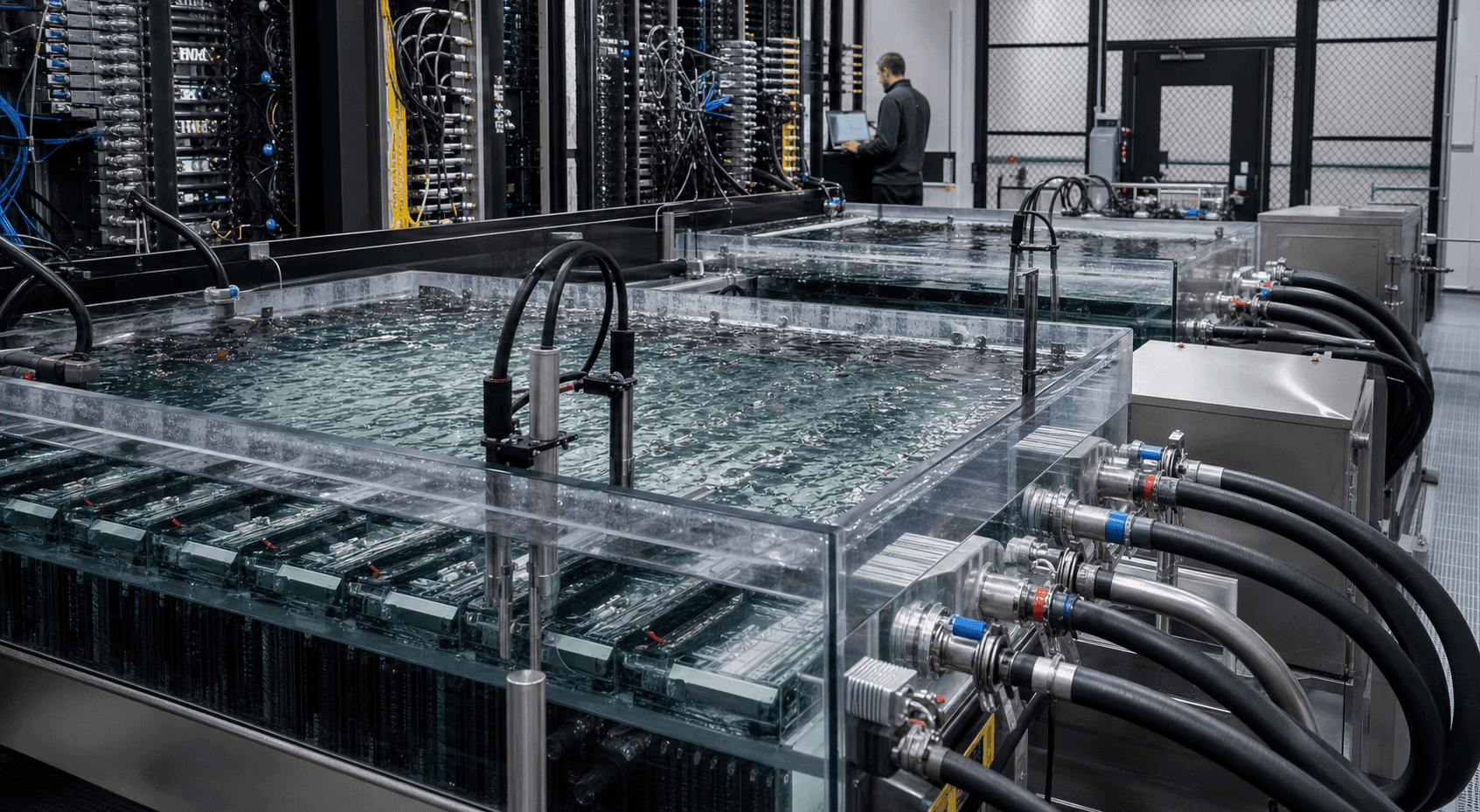
The physical plane deserves specific attention in immersion environments. Tanks, dielectric fluid, CDU units, pumps, manifolds, probes and fiber paths must be part of the operating model. They are not technical scenery; they directly condition available capacity, maintenance and workload placement.
Daily operating model
The operating model must make normal actions visible: change, patching, secret rotation, restore testing, physical intervention, capacity review and alert handling. For this topic, the daily foundation includes quotas, priorities, inference logs, model control, dataset recovery, access review and cost-per-request measurement. These operations should produce traces that are easy to review, not only scattered events across several consoles.
A useful runbook defines the trigger threshold, owner, prerequisites, risk, evidence to preserve and return-to-normal decision. This concise format avoids decorative procedures. It helps teams under pressure because it connects the technical action to a business consequence and usable evidence.
Immersion cooling and useful capacity
Immersion cooling changes the equation because it concentrates more power in a controlled footprint. Density alone is not a win. It becomes useful only when workloads can be delivered, monitored, maintained and restored under real pressure. A full tank does not guarantee a robust service if CDU margin, access, backups or network dependencies are poorly understood.
The practical move is to connect physical metrics with cloud metrics. A temperature alert must be understood by the platform team. GPU saturation must be read with cooling context. A maintenance window must verify backup state and supporting services. This connection provides a more reliable view of capacity that can actually be used.
Cloud, VPS and supporting services
Auxiliary services are often the weak point in ambitious architectures. Bastions, backup relays, probes, repositories, DNS, VPN, internal portals and small VPS instances carry critical access paths or dependencies. They therefore need the same rigor as the central platform, even when they look modest.
The practical model requires known system images, patch policy, named access, restored backups, centralized logs and a revocation procedure. Teams can standardize those elements with Wayhost for VPS building blocks and with ITNET Technologies for integration into the broader security model. The expected result is repeatable operations, not a collection of exceptions.
Cybersecurity, compliance and evidence
Cybersecurity must be embedded in the architecture from the start. It defines identities, network zones, administration paths, secrets, logs, restores and crisis scenarios. Useful evidence is not always dramatic: a revoked access, restored backup, documented CDU threshold or handled alert can be enough to demonstrate control.
This logic also protects the customer relationship. An organization that can explain where a workload runs, who can intervene, how rollback works and which physical limits are monitored earns credibility. By contrast, a powerful but opaque architecture becomes difficult to defend as soon as an incident affects sensitive data or a contractual commitment.
Practical 90-day plan
The first 30 days should produce an actionable map: services, accounts, flows, backups, dependencies, cooling thresholds, suppliers, responsibilities and exceptions. The objective is not a perfect inventory. It is to identify what would be slow to restore, hard to isolate or impossible to explain to a customer.
From day 30 to day 60, the team standardizes models: hardening, bastions, backups, segmentation, dashboards, placement criteria and short runbooks. From day 60 to day 90, it tests concrete scenarios: privileged account loss, full restore, CDU saturation, storage failure, support VPS outage or migration of a sensitive workload. Each exercise must produce a measurable improvement.
Mistakes to avoid
The first mistake is confusing capacity with resilience. An available resource is not necessarily restorable. The second mistake is mixing sensitive data with unclassified processing, ignoring queues or losing traceability of internal prompts. The third mistake is placing backlinks, evidence or sources as a final add-on instead of integrating them naturally into the reasoning.
Teams should also avoid decorative metrics. A dashboard that triggers no action does not protect the service. An alert with no owner does not reduce risk. A backup that has never been restored creates false confidence. Operational quality is measured by the ability to turn a signal into a decision, then a decision into evidence.
KPIs to follow
The priority indicators are p95 latency, cost per thousand requests, useful GPU occupancy, access incidents, CDU margin and classified workload rate. They should be readable at two levels: a short leadership view and a technical view capable of triggering action. Each indicator needs a threshold, an owner, an associated procedure and enough history to be meaningful.
These KPIs should also be connected. Higher latency can come from a queue, network saturation, reduced thermal margin or degraded supporting service. Teams save time when they can move quickly from symptom to responsible component, then from responsible component to documented action.
What matters most
Premium infrastructure is not distinguished only by power. It is distinguished by evidence quality, clear accountability and the ability to maintain service under pressure. The link between cloud, datacenter, VPS, immersion cooling, Voltaneum and cybersecurity should therefore form one operating model.
The robust path is to reduce blind spots, test procedures and make every tradeoff explainable. That discipline turns complex architecture into a trusted platform. It gives technical teams an action framework and decision makers proof that the infrastructure can meet its commitments.
FAQ
Why connect immersion cooling and cybersecurity in the same model?
Because physical capacity directly influences placement, availability and recovery. A sensitive workload is truly protected only when access, backups and operating thresholds are governed together.
Should a supporting VPS follow the same requirements as the central platform?
Yes, when it carries a bastion, probe, backup relay or administration service. A modest component can become critical if it concentrates access or logs.
What deliverable should come first?
The most useful first deliverable is a short map of services, dependencies, backups, privileged accounts and physical thresholds, supported by two restore tests actually executed.
Sources
- ENISA, Threat Landscape 2025: https://www.enisa.europa.eu/publications
- NIST, Cybersecurity Framework 2.0: https://www.nist.gov/cyberframework
- European Commission, NIS2 Directive: https://digital-strategy.ec.europa.eu/en/policies/nis2-directive
- EIOPA, Digital Operational Resilience Act: https://www.eiopa.europa.eu/digital-operational-resilience-act-dora_en
- Uptime Institute, datacenter resiliency and operations: https://uptimeinstitute.com/resources