



Search intent: design a private GPU cloud for AI inference with sovereignty, immersion cooling and measurable operations.
Voltaneum and private GPU cloud: placing AI inference where it stays controlled
Why this topic matters now
AI inference is moving from labs into business processes: document search, support, industrial vision, cybersecurity, automation and internal assistants. These uses often handle sensitive information. GPU placement is therefore a sovereignty, cost, latency and evidence decision, not only a performance choice.
Voltaneum fits this need with GPU and cloud infrastructure designed for density. Wayhost remains useful for supporting portals, bastions and operational VPS services. ITNET Technologies provides the architecture, integration and cybersecurity frame that turns raw capacity into a reliable service.
The real shift for private AI
The question is no longer whether a model can answer. The question is where it answers, with which data, which isolation and which traceability. Companies must avoid scattering prompts, embeddings, logs and results across environments outside their governance. Private inference requires a clearer chain.
This shift connects GPU, storage, network, identity and cooling. A reliable AI platform is not defined only by the number of available accelerators. It is defined by data control, predictable latency, capacity monitoring and the ability to explain each operating decision.
Target GPU cloud architecture
A credible architecture separates training, inference, administration and observability zones. Sensitive data flows must be identified, encrypted and limited. Operator access should use named accounts, bastions and usable logs. Critical AI workloads need quotas, priorities and known maintenance windows.
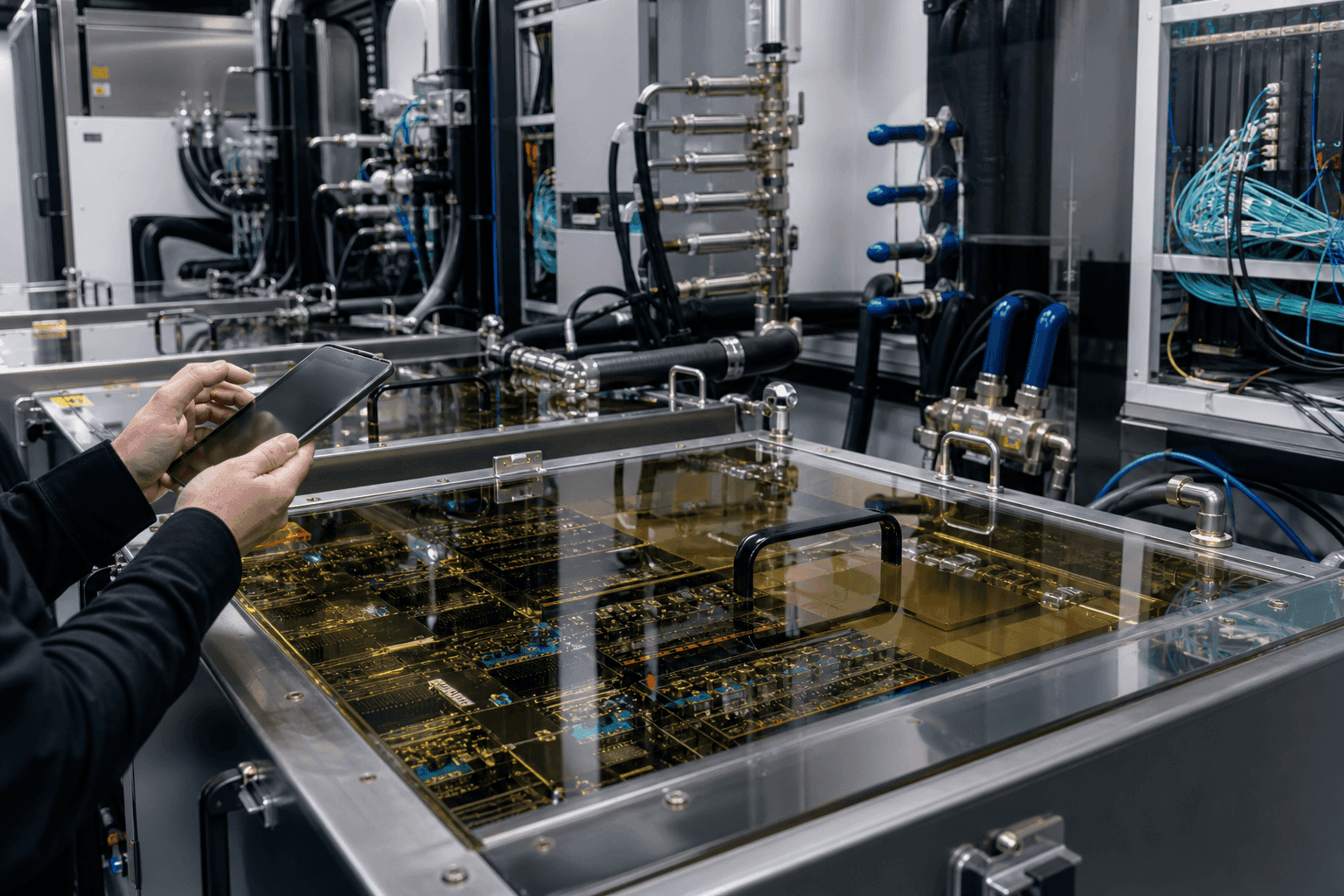
The physical layer matters as much as the software layer. Immersion tanks, dielectric fluids, CDU units, manifolds, sensors, fiber and power feeds must be modeled as service dependencies. Without that view, thermal saturation or maintenance can become an application outage that teams struggle to explain.
Immersion cooling and useful GPU density
GPUs concentrate heat, cost and value. Immersion cooling can align density, thermal stability and continuous operations when procedures are disciplined. Fluid quality, clean interventions, pump monitoring, CDU tracking and alert thresholds become part of the cloud service.
The right indicator is not only GPU utilization. Teams should measure useful capacity: tokens served, stable latency, errors, consumption, thermal margin and recovery time. High density that degrades predictability or complicates maintenance destroys part of the expected benefit.
Data security and governance
Private AI inference must protect more than source files. It must also protect prompts, outputs, logs, vectors, enriched models and metadata. Access secrets, document connectors and technical accounts should be treated as critical assets. A context leak can be as damaging as a document repository leak.
Governance should define who may call which model, with which data, from which zone and with which retention period. Rules must stay understandable for business teams. An abstract policy will be bypassed; a clear policy creates trust.
Practical 90-day plan
The first month selects high-value, controlled use cases: internal search, ticket analysis, summary generation or assistance for technical teams. Each use case should describe data, expected latency, users, logs, retention and GPU need. This avoids sizing the platform blindly.
The second month defines the platform: network zones, storage, models, quotas, backups, bastions, monitoring and thermal thresholds. The third month runs realistic tests: load increase, node loss, CDU saturation, access revocation, configuration restore and cost measurement per use.
Mistakes to avoid
The first mistake is treating private AI as a simple GPU farm. Without data governance, risk moves to prompts, connectors and logs. The second mistake is promising global capacity without reserving priority workloads. A weak queue design quickly creates frustration.
The third mistake is ignoring the link between cooling and service commitments. An inference platform must know its thermal thresholds, maintenance procedures and degraded modes. The fourth mistake is forgetting surrounding services: DNS, bastions, repositories, observability and backups.
KPIs to follow
Useful indicators combine performance, security and operations. Track P95 latency, tokens per second, error rate, cost per request, GPU occupancy, CDU margin, recovery time, usage by business domain and access events. These measures should be readable by platform teams and sponsors.
An effective dashboard separates available capacity, reserved capacity and truly useful capacity. It also shows exceptions: an overly expensive model, a noisy connector, an out-of-policy request or a thermal threshold approaching the limit. This transparency makes private AI manageable.
What matters most
A successful private GPU cloud is not only a stack of accelerators. It connects sovereignty, data, network, cooling, security and business experience. Immersion cooling brings density, but value depends on operations and evidence.
The right path starts with a few measurable use cases, then industrializes. With clear architecture, controlled access and monitored thermal capacity, AI inference becomes a reliable service instead of a permanent experiment.
Production readiness and continuous governance
Production readiness should be treated as a transfer of responsibility, not as a technical handover only. Before opening the service, the team should verify owners, dependencies, privileged access, backups, alert thresholds, escalation procedures and expected evidence. This review avoids discovering later that a secondary component blocks recovery or that an essential indicator was never collected.
Continuous governance then needs a simple rhythm: monthly risk review, quarterly restore testing, regular access control, analysis of minor incidents and runbook updates after every meaningful change. Decisions should remain short and traceable. An accepted exception needs an end date, an owner and a compensating measure. Without that discipline, platforms accumulate silent tolerances that become expensive when pressure rises.
Financial governance also belongs in the model. Leaders should not compare only hosting price or hardware cost. They should connect truly useful capacity, operating time, energy use, avoided risk, recovery quality and protected business value. This view produces healthier trade-offs, especially when AI, high density and cybersecurity meet in the same budget.
Documentation must remain operational. A long document that nobody reads does not protect the platform. The best teams prefer short runbooks that are tested, versioned and connected to dashboards. They know who decides, what to isolate, what to restore and which message to send. That demanding simplicity is what keeps quality stable over time.
This last step is often where premium infrastructure differs from ordinary infrastructure. The design may be elegant, but the service becomes trustworthy only when evidence is produced repeatedly. Teams should keep proof of restore tests, access reviews, capacity changes, security exceptions, supplier interventions and physical maintenance. These records are not bureaucracy when they help engineers make faster decisions during a real incident. They also make executive reporting more credible because the report is grounded in operating facts rather than optimistic assumptions.
Governance should also include communication rules. During a disruption, technical teams lose time when every stakeholder asks for a different status view. A prepared model defines who receives operational detail, who receives business impact, who speaks to customers and which evidence can be shared. This prevents improvisation and protects engineers from parallel reporting pressure while they restore service. Clear communication is part of resilience because it preserves focus, trust and decision speed.
FAQ
When should a private GPU cloud be chosen?
When an AI use case handles sensitive data, needs predictable latency or requires clear governance for logs and access.
Does immersion cooling guarantee performance by itself?
No. It improves density and thermal stability, but quotas, queues, models and operations remain decisive.
Which workloads should start first?
Choose useful and controlled cases: internal search, support, document summaries, cybersecurity or assistance for operations teams.
Sources
- European Commission, NIS2 Directive: https://digital-strategy.ec.europa.eu/en/policies/nis2-directive
- EIOPA, Digital Operational Resilience Act: https://www.eiopa.europa.eu/digital-operational-resilience-act-dora_en
- NIST, Cybersecurity Framework 2.0: https://www.nist.gov/cyberframework
- IEA, Energy and AI: https://www.iea.org/reports/energy-and-ai/energy-demand-from-ai