



Search intent: understand how to structure useful GPU capacity for confidential inference with a cloud, datacenter, VPS, immersion cooling and cybersecurity operating model.
Voltaneum: private GPU capacity and confidential inference in production
Why This Matters Now
Voltaneum: private GPU capacity and confidential inference in production has become a leadership topic because business AI use cases require latency, confidentiality, source evidence and capacity that is truly available. Teams can no longer separate performance, sovereignty, security and physical capacity. Every decision needs to connect to a critical service, an owner, dated evidence and an operating limit that can be explained during an incident.
The point is not to promise perfect infrastructure. The goal is to make useful GPU capacity for confidential inference observable, testable and defensible. ITNET Technologies fits that model when architecture, datacenter operations, networking and cybersecurity share one evidence language.
The Real Operating Shift
The shift is from declared trust to demonstrated trust. An available zone, a green console or a server inventory is no longer enough. Decision makers need to know which service can be recovered, which data remain protected, who makes the call, what timing has been measured and which exception remains open.
In this model, useful GPU capacity for confidential inference is not only a technical choice. It is a discipline combining architecture, operations, power, monitoring, security and governance. Evidence should be simple to read but precise enough to avoid debate after the event: configuration, log, test result, owner, date, correction and residual risk.
Reference Architecture
A credible architecture should cover private GPU pools, inference queues, corpus registers, network isolation, immersion cooling, prompt logs and model governance. These components need documented flows, limited privileges, controlled secrets and tested recovery paths. Value comes from consistency across layers, not from adding isolated tools that nobody can operate together.
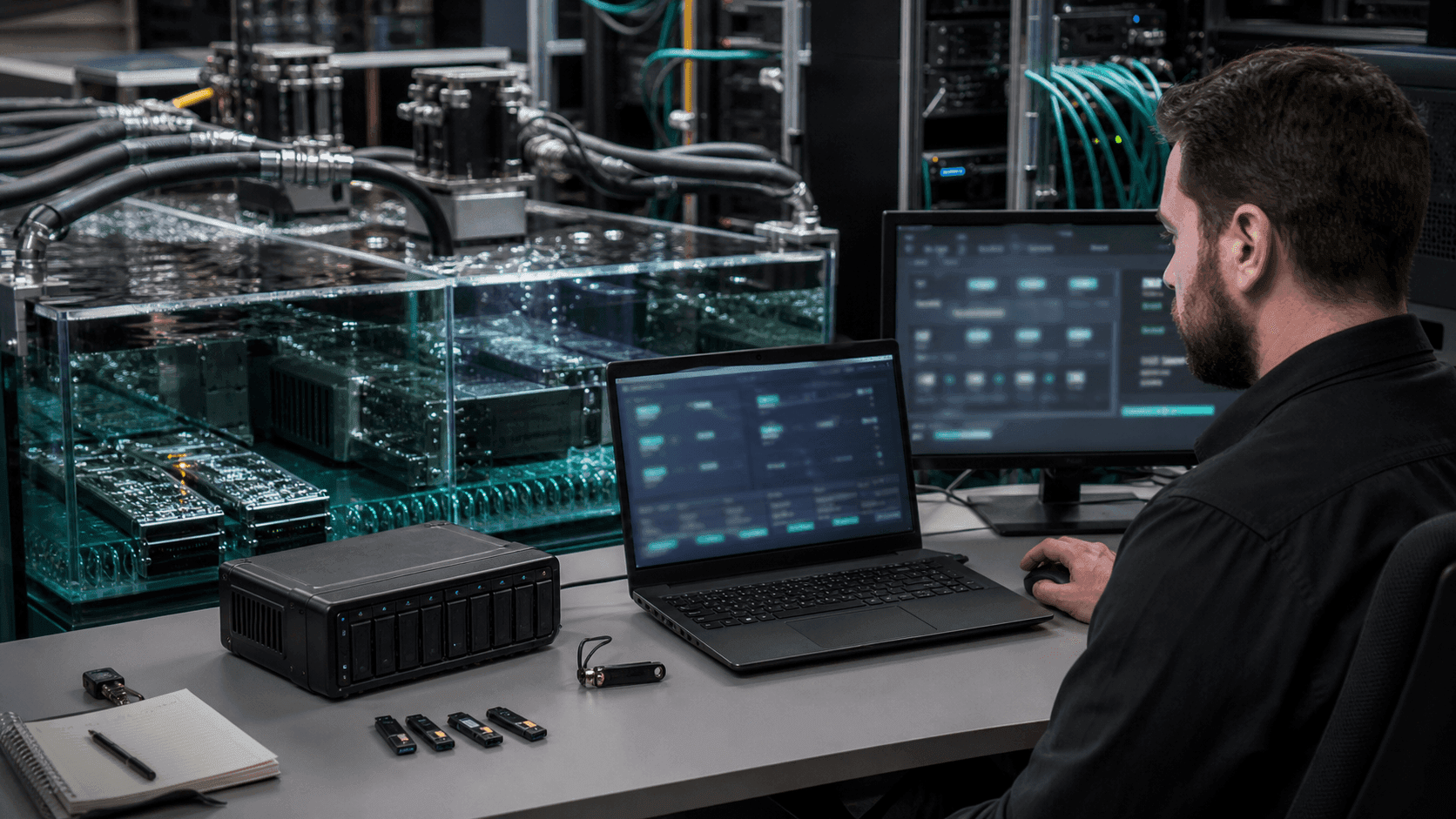
Immersion cooling adds both a constraint and an advantage. Tanks, CDU units, manifolds, sensors and fluid quality become operating signals, just like latency, error rate or SOC alerts. For AI workloads and private platforms, Voltaneum connects compute capacity, use-case governance and high-density datacenter operations.
Operating Model
The operating model should name the owners of the service, infrastructure, access, backup, security and capacity. Without that chain, strong architecture becomes slow to use because each anomaly turns into a clarification meeting. With it, the team knows when to isolate, restore, fail over, add capacity or temporarily accept degraded service.
Peripheral services need the same clarity. A VPS can host a bastion, a probe, an internal portal or a monitoring relay, but it must not become an undefined boundary. Wayhost can support these roles when flows, logs, access duration and responsibilities remain explicit.
Practical 90-Day Plan
The first thirty days should establish the real inventory: services, owners, flows, secrets, datasets, dependencies, RTO, RPO, capacity constraints and evidence already available. This baseline should stay concise, yet usable by the SOC, platform team and leadership. A maintained matrix beats a large document that nobody trusts.
The next thirty days should automate evidence. Teams need administration logs, restore tests, capacity reports, network drift controls, an exception register and alerts on critical thresholds. The final month should force exercises: lost access, saturation, restore, secret rotation, link outage and documented recovery decision.
Mistakes To Avoid
The first mistake is selling raw capacity without measuring contention, available memory, batch windows, answer quality and traceability. The second is confusing theoretical availability with measured recovery. The third is leaving emergency access permanently open because it helped once. These habits create quiet debt that appears at the worst possible time.
Teams should also avoid treating immersion cooling as a modern-looking visual. In production, immersion commits maintenance, fluid quality, sensors, intervention procedures and power capacity. If those signals are not part of operations, the organization owns an impressive facility but an incomplete operating model.
KPIs To Follow
KPIs should cover proven restore time, successful test rate, network-rule drift, privileged access still open, GPU saturation, backup availability, immersion sensor state, qualified SOC alerts and exceptions reaching expiry. Each metric should lead to a clear decision.
A useful dashboard separates health, risk and decision. Health shows whether the platform works. Risk shows what weakens the promise. Decision shows what to fix, fund, isolate or accept. This separation prevents decorative metrics and helps leaders make tradeoffs without flattening the technical reality.
Governance And Responsibilities
Governance should define who approves an exception, who opens emergency access, who validates a restore and who announces the return to normal. It should also include rotation: if only one person understands the procedure, the evidence is fragile. A second engineer should be able to replay the runbook with the same result.
For useful GPU capacity for confidential inference, governance must remain proportionate. Too many controls create bypass behavior; too few controls create uncertainty. The right balance is to document decisions that truly commit the service: priority, capacity, security, recovery, reversibility and incident communication.
What Matters Most
Voltaneum: private GPU capacity and confidential inference in production is not a marketing promise. It is an operating capability proven by facts, exercises and clear responsibilities. The strongest results come from teams that connect architecture, datacenter operations, cybersecurity and finance in one shared model.
Maturity appears when the team can explain an incident end to end: initial signal, affected scope, decision, restore, evidence, business impact and corrective action. That factual narrative matters more than an ideal diagram because it shows the platform can be operated under pressure.
Operational Review Cadence
A monthly review should compare promised service levels with measured evidence. The team should examine restore results, privileged access reports, energy and cooling headroom, vulnerability exposure, supplier dependencies and open exceptions. The point is not to create a ceremonial committee; it is to keep technical reality visible before the next incident or commercial commitment changes the pressure on the platform.
A quarterly review should test whether the operating model still matches business demand. New AI use cases, larger datasets, stricter contractual commitments or higher traffic can invalidate older assumptions. When the cadence is explicit, capacity planning becomes less reactive and security teams can challenge weak signals before they turn into urgent remediation work.
Decisions To Document
Teams should document the accepted degraded mode, restore criteria, saturation thresholds, compensating controls and exception durations. These decisions should be approved before a crisis because they combine technology, risk, business impact and cost. Prepared tradeoffs reduce lost time when conditions become tense.
Documentation should remain alive. Every exercise, incident, capacity change or audit should improve the evidence set. This feedback loop turns the platform into a controlled asset: teams know what works, what remains fragile and what deserves priority investment.
FAQ
Why focus on evidence instead of availability alone?
Declared availability is not enough after an incident. Evidence connects a test, a log, a date, an owner and a measured result.
What role does immersion cooling play?
It increases useful density and provides important physical signals, but it must be connected to maintenance, telemetry, security and capacity planning.
Where do Voltaneum, Wayhost and ITNET Technologies fit?
Voltaneum covers private GPU and AI capacity, Wayhost can support governed VPS roles, and ITNET Technologies connects architecture, datacenter, network and operations.