


Search intent: understand how to choose and qualify power cables for immersion cooling without reducing safety to the dielectric fluid alone.
Power cables in immersion cooling: safety, materials and operations
Immersion cooling uses dielectric fluid, meaning the fluid is electrically insulating under its intended operating conditions. This property is essential, but it should not create a false sense of simplicity. Power cables, connectors, server power supplies, PDU, busbars and protection devices remain critical infrastructure components. They carry the energy that makes the platform run.
For readers designing a high-density datacenter or AI platform, the question is not only "can this cable be submerged?" The stronger question is: does this cable keep its mechanical, electrical and safety properties in this fluid, at this temperature, under this load, for this duration and under this maintenance procedure?
Voltaneum is directly concerned when GPU density increases electrical demand. Wayhost remains relevant for hosted services that depend on continuity. ITNET Technologies helps connect power, cooling, cybersecurity and operations into a coherent architecture.
Power Reference Table
Power cables must be sized according to local electrical codes, protection devices and supplier recommendations. The table below gives practical planning numbers to show why high-density servers quickly exceed ordinary cabling assumptions.
| Supply | Theoretical power | 80% continuous load | Practical reading |
|---|---|---|---|
| 230 V single-phase 16 A | 3.68 kW | 2.94 kW | insufficient for one dense GPU server |
| 230 V single-phase 32 A | 7.36 kW | 5.89 kW | tight for a high-end AI server |
| 400 V three-phase 32 A | 22.2 kW | 17.7 kW | suitable for a small server group |
| 400 V three-phase 63 A | 43.6 kW | 34.9 kW | coherent with a dense tank or zone |
| 8 kW server at 230 V | 34.8 A | not applicable | needs multiple feeds or adapted distribution |
Concrete illustration: an 8 kW AI server cannot be treated like a conventional 1U server. At 230 V, it represents roughly 34.8 A. Even with dielectric fluid, power distribution, connectors, protection and maintenance must be designed for the real load.
Dielectric Fluid Does Not Replace Electrical Safety
Dielectric fluid reduces conduction risk in normal conditions, but it does not remove electrical design obligations. Protection, cable cross-section, connector ratings, grounding, selectivity, emergency shutdown, documentation and lockout procedure remain mandatory.
The risk profile changes. In immersion, teams must examine fluid compatibility with insulation, jacket behavior, connection points, mechanical strain and human intervention. A cable that softens, swells, cracks or loses identification can create a serious issue before a visible failure occurs.
Insulation, Jackets And Material Compatibility
Power cables use insulation and jackets that do not all react the same way to immersion fluids. Some materials may leach additives, change dimensions, lose flexibility or evolve mechanically. Compatibility must therefore be validated on the exact cable reference, not only on a generic cable family.
OCP immersion guidance emphasizes material compatibility and associated tests. Readers should ask for test conditions: fluid type, temperature, duration, mass or dimensional variation, visual inspection and acceptance criteria. Serious projects do not rely on a single marketing sentence.
Power Connectors And Connection Zones
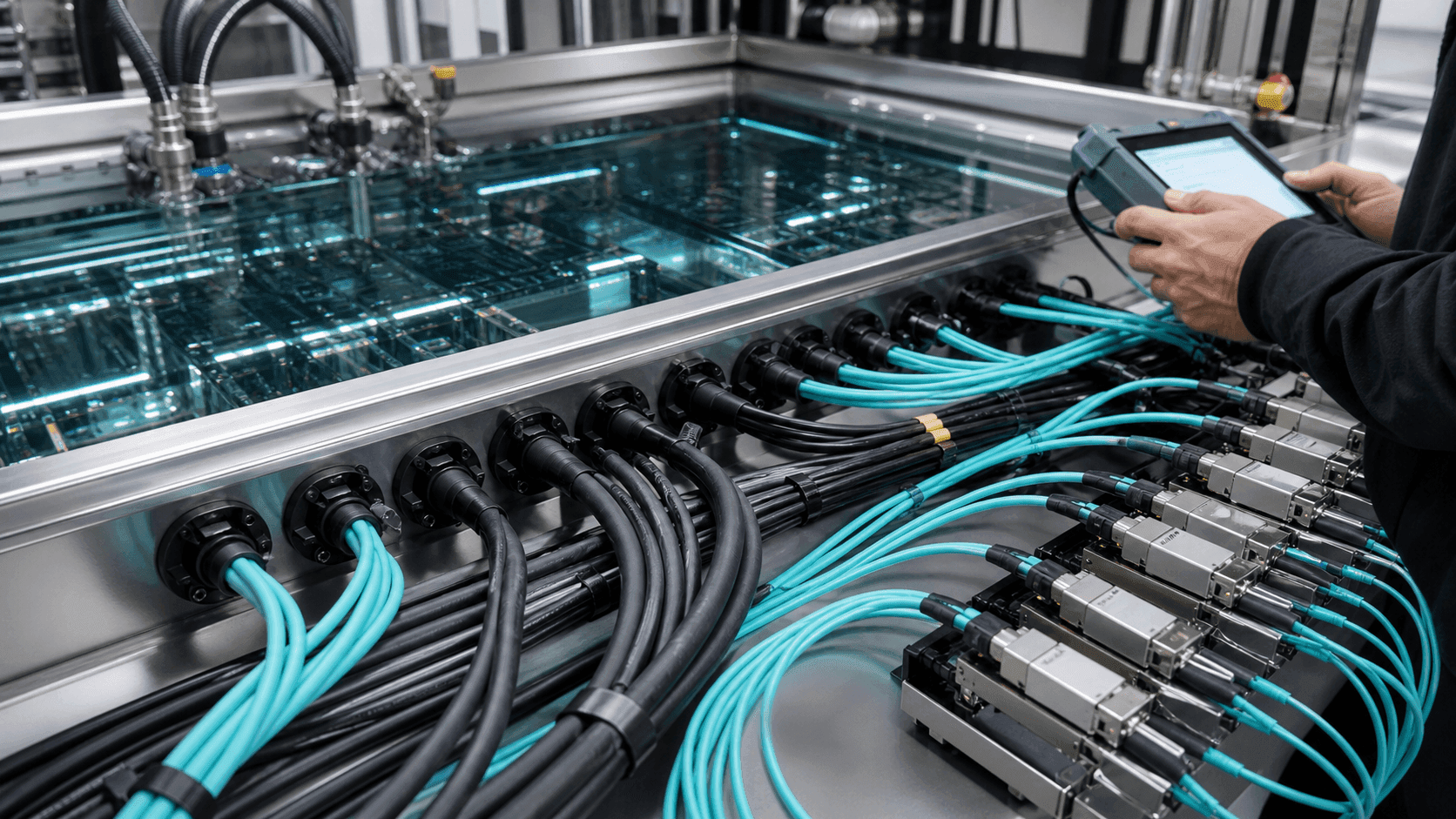
The cable is only part of the issue. Connectors, contacts, locks, keying, seals, plastics and labels can be more sensitive than copper. In immersion, teams must know which elements sit in the fluid and which remain dry.
A good design avoids improvised connections above or near the tank. It defines clean routing, reasonable spare length, controlled bend radius, protected exits and durable identification. Connectors must be handled through a known procedure by trained staff, with traceability.
PDU, Busbars And High-Density Distribution
As GPU racks and tanks become denser, power distribution becomes central to design. PDU, busbars, protection devices and connection points should be planned with cooling, not bolted on later. Available power has little value if it cannot be distributed safely and maintained.
Some architectures move toward more integrated rack or tank-level distribution. Readers should verify mechanical, thermal and operational compatibility of the whole chain. OCP and ORV3 discussions show that power, cooling and interconnects are now interdependent.
Load, Temperature And Exposure Duration
A power cable must be qualified for its real load. Fluid temperature, circulation, cable grouping, local hot spots and mechanical constraints influence service life. A cable correctly sized in air should not be assumed equivalent inside a tank without analysis.
Qualification should include degraded scenarios: reduced pump flow, higher fluid temperature, maintenance, partial shutdown, server replacement, added load and cable rerouting. Datacenters do not live in perfect static conditions. Cables must remain reliable when operations change.
Maintenance And Intervention Safety
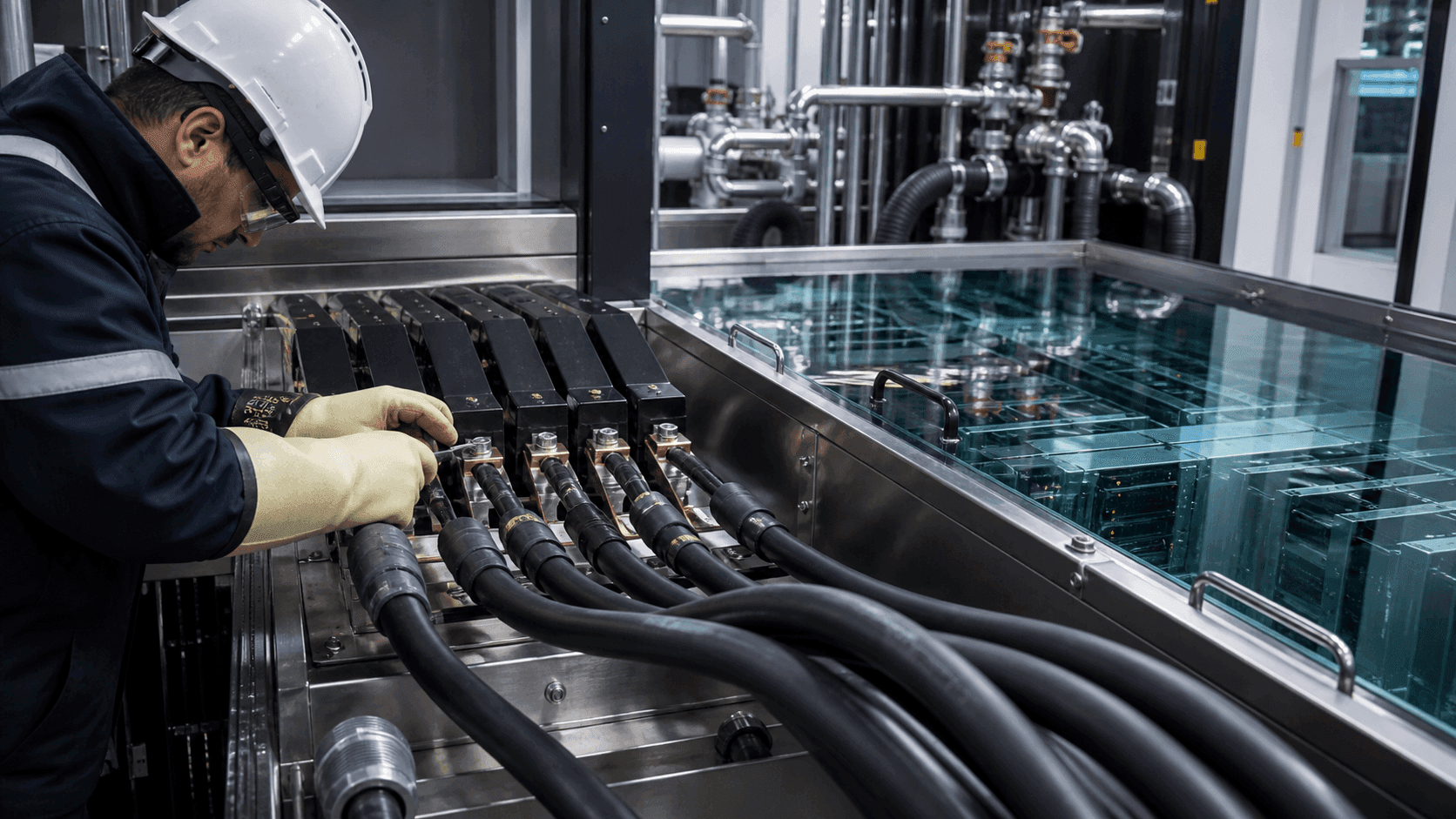
Electrical interventions in immersion should be rare, prepared and traceable. Teams must define who can intervene, under which load state, with which lockout procedure, which protective equipment and which return-to-service checks. A power cable should not be moved casually because it blocks a network intervention.
Maintenance should also include visual inspection. Is the jacket intact? Are markings readable? Does the cable remain flexible? Do connectors lock correctly? Is routing still clean? Minor incidents should be recorded because they can reveal progressive incompatibility.
Cyber Resilience And Continuity
Power may seem far from cybersecurity, but it directly affects resilience. A poorly managed outage, unsupervised PDU, cabling error or untracked intervention can cause critical downtime. Logs, electrical supervision and change procedures belong in the governance model.
In cloud or AI platforms, power cables support business services, backups, bastions, GPU clusters and customer environments. Their management must align with continuity requirements. Electrical changes should be planned, approved and auditable.
Qualification Checklist
Before purchase or deployment, ask whether the cable reference is validated with the selected fluid. Does the test temperature and duration match the project? Are connectors included in validation? Do labels resist the fluid? Is the cable section adapted to real load? Does routing respect mechanical constraints? Are lockout and replacement procedures written? Does replacement stock use the same validated reference?
This checklist prevents a common mistake: qualifying tanks and servers, then buying power cables as standard consumables. In immersion cooling, the compatibility chain must be complete.
Mistakes To Avoid
The first mistake is believing dielectric fluid permits electrical compromises. It reduces some risks but never replaces compliant design.
The second mistake is validating a cable without its connectors. The weak point may be the connector plastic, locking mechanism, marking or transition zone.
The third mistake is changing cable reference during maintenance without requalification. A quick substitution can introduce an incompatible jacket or adhesive.
What Matters Most
Power cables in immersion cooling must be treated as infrastructure components, not accessories. Compatibility depends on fluid, materials, connectors, load, temperature, maintenance and traceability.
Readers preparing high-density platforms should require evidence and clear procedures. That rigor is what turns immersion cooling into a reliable production model for cloud, VPS, AI and cybersecurity workloads.
FAQ
Can standard power cables be used in immersion?
Not without validation. The cable, jacket, connectors and markings must be compatible with the exact project fluid.
Does dielectric fluid remove electrical risk?
No. It reduces conduction in normal conditions, but electrical design, protection, lockout and maintenance remain essential.
What should be monitored over time?
Jacket condition, connector locking, label readability, heating, load stability, PDU incidents, cabling changes and replacement-stock conformity.
Sources
- Open Compute Project, Design Guidelines for Immersion-Cooled IT Equipment: https://www.opencompute.org/documents/design-guidelines-for-immersion-cooled-it-equipment-revision-1-01-pdf
- Molex, Data Center Power Management Solutions: https://www.molex.com/en-us/industries-applications/power-for-data-center
- Molex, Data Center Evolution: ORV3 Immersion Cooling Insights: https://www.molex.com/en-us/blog/orv-immersion-cooling-insights
- ASHRAE TC 9.9, Mission Critical Facilities and Datacom guidance: https://tpc.ashrae.org/?cmtKey=fd4a4ee6-96a3-4f61-8b85-43418dfa988d