



Search intent: prepare a datacenter migration to immersion cooling to absorb AI demand, reduce risk and protect continuity.
AI datacenter migration: moving to immersion cooling without breaking operations
Why this topic matters now
AI workload growth forces datacenters to rethink power, cooling, density and continuity. Conventional air-cooling architectures often reach limits when GPUs concentrate heat and value in little space. Moving to immersion cooling becomes a strategic option, but it cannot be treated as a simple equipment swap.
Voltaneum illustrates this high-density cloud and GPU logic. Wayhost remains relevant for VPS and supporting platforms that must continue during transition. ITNET Technologies provides the architecture, cybersecurity and governance method required for controlled migration.
The real model change
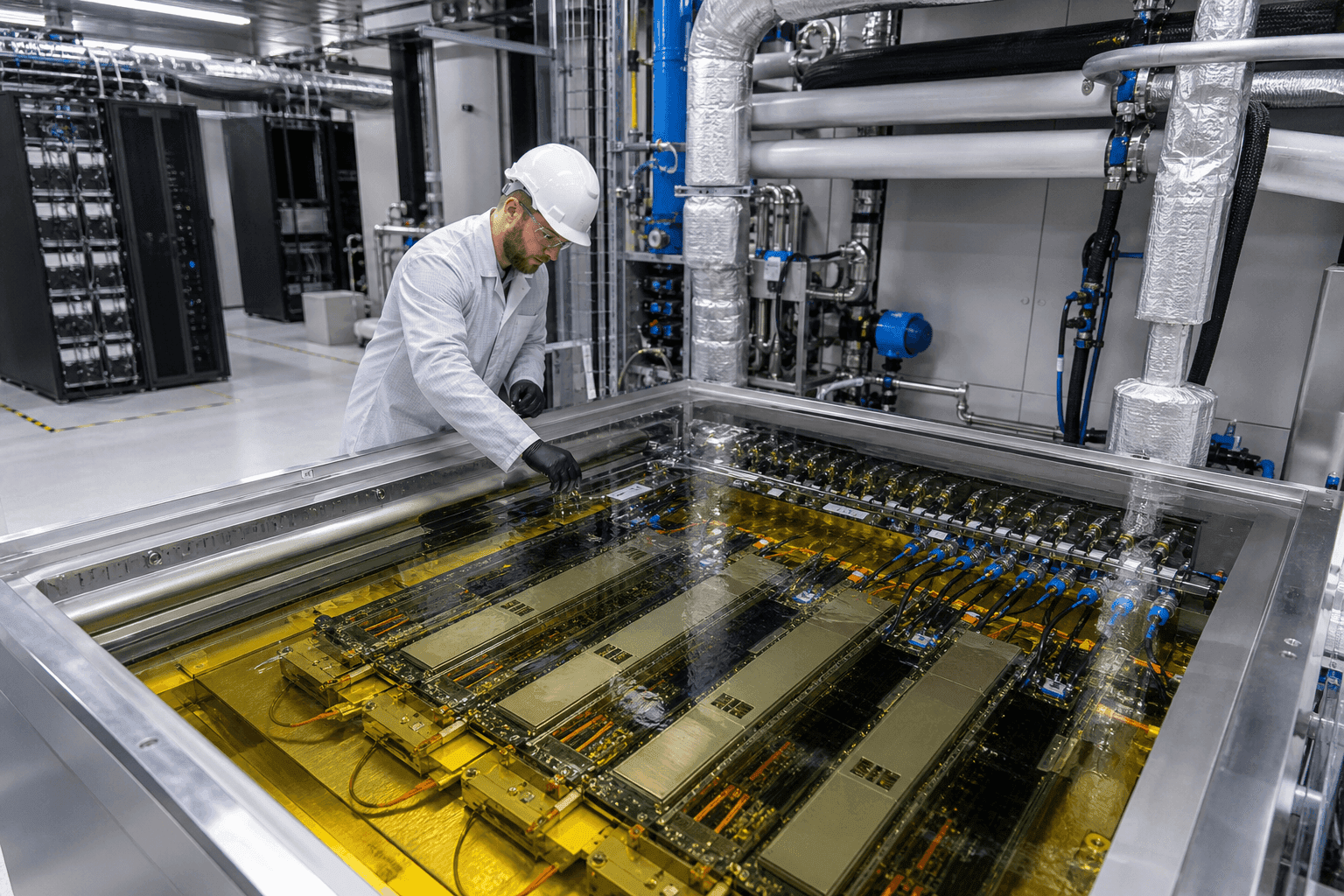
Migration to immersion cooling changes the relationship between building, energy, server and application. Capacity is no longer planned only through racks, aisles and air flow. It is planned through tanks, fluids, CDU units, heat exchangers, pumps, fittings, sensors, maintenance and degraded scenarios.
Infrastructure, security, application and finance teams must understand this change. A GPU placement decision also becomes a thermal, electrical, operational and contractual decision. Without shared language, migration may create silos more expensive than the old model.
Target architecture and path
The healthiest path starts with a pilot zone. It hosts representative workloads with clear dependencies, maintenance windows and rollback criteria. This zone should prove operating gestures: installation, replacement, cleaning, monitoring, CDU incident, leak response, controlled shutdown and restore.
The target architecture must also cover network, fiber, storage, backups and administrative access. Immersion cooling does not replace cloud governance; it makes it more necessary. As density increases, poor dependencies create faster consequences.
Security and continuity during migration
Technical migration often creates risk windows. Temporary access appears, network rules are opened, procedures change and suppliers intervene. Each exception should be dated, justified, followed and removed. Otherwise, migration leaves invisible cyber debt behind.
Continuity also requires realistic rollback capacity. Critical applications must know their backups, dependencies and recovery times. Moving a workload into an immersion tank without restore testing or network validation remains an excessive risk.
Tank and CDU operations
Immersion tanks and CDU units become service components. Teams need to follow temperature, flow, fluid quality, pressure, alarms, consumption and spare availability. Interventions should be written, repeatable and understandable by several people. Competence must not live only in one expert's head.
The runbook should describe thresholds, responsibilities and decisions. What happens if a pump becomes unstable? Which workload moves if thermal margin drops? Who approves intervention inside a tank? These answers should exist before a crisis.
Practical 90-day plan
The first month analyzes power, workloads, applications, dependencies, building constraints, energy contracts, network, backups and cyber risks. This snapshot should separate candidate workloads, blocking dependencies and operations that cannot be interrupted.
The second month prepares the pilot zone: design, security, monitoring, procedures, training and success criteria. The third month executes tests: migrating a batch, load increase, simulated CDU incident, application restore, temporary access revocation and consumption review. The result should decide extension, not merely celebrate installation.
Mistakes to avoid
The first mistake is migrating only to increase density. Density without procedures increases risk. The second is forgetting peripheral applications: monitoring, DNS, bastions, backups and portals can block service even if GPUs keep running.
The third mistake is underestimating change management. Operating gestures differ, perceived risks change and responsibilities must be redefined. The fourth is neglecting evidence: before-and-after measures, recovery tests, simulated incidents and corrections must be retained.
KPIs to follow
Key indicators are useful power by zone, CDU margin, stable temperature, flow, workload availability, application latency, intervention time, successful restores, open cyber exceptions and consumption by service. These measures should be compared with the previous model.
Financial steering also matters. Teams should connect density, consumption, maintenance, delivered capacity and service quality. A successful migration is not proven by a tank photo, but by measurable and repeatable results.
What matters most
Migration to immersion cooling is an operations transformation. It provides a credible response to AI density, but only if it connects architecture, security, energy, maintenance and continuity. The tank becomes a service component, not an isolated object.
The right method progresses through pilot, evidence and controlled extension. Teams that document gestures, test incidents and follow useful capacity obtain a denser, clearer and more resilient foundation.
Production readiness and continuous governance
Production readiness should be treated as a transfer of responsibility, not as a technical handover only. Before opening the service, the team should verify owners, dependencies, privileged access, backups, alert thresholds, escalation procedures and expected evidence. This review avoids discovering later that a secondary component blocks recovery or that an essential indicator was never collected.
Continuous governance then needs a simple rhythm: monthly risk review, quarterly restore testing, regular access control, analysis of minor incidents and runbook updates after every meaningful change. Decisions should remain short and traceable. An accepted exception needs an end date, an owner and a compensating measure. Without that discipline, platforms accumulate silent tolerances that become expensive when pressure rises.
Financial governance also belongs in the model. Leaders should not compare only hosting price or hardware cost. They should connect truly useful capacity, operating time, energy use, avoided risk, recovery quality and protected business value. This view produces healthier trade-offs, especially when AI, high density and cybersecurity meet in the same budget.
Documentation must remain operational. A long document that nobody reads does not protect the platform. The best teams prefer short runbooks that are tested, versioned and connected to dashboards. They know who decides, what to isolate, what to restore and which message to send. That demanding simplicity is what keeps quality stable over time.
This last step is often where premium infrastructure differs from ordinary infrastructure. The design may be elegant, but the service becomes trustworthy only when evidence is produced repeatedly. Teams should keep proof of restore tests, access reviews, capacity changes, security exceptions, supplier interventions and physical maintenance. These records are not bureaucracy when they help engineers make faster decisions during a real incident. They also make executive reporting more credible because the report is grounded in operating facts rather than optimistic assumptions.
Governance should also include communication rules. During a disruption, technical teams lose time when every stakeholder asks for a different status view. A prepared model defines who receives operational detail, who receives business impact, who speaks to customers and which evidence can be shared. This prevents improvisation and protects engineers from parallel reporting pressure while they restore service. Clear communication is part of resilience because it preserves focus, trust and decision speed.
FAQ
Should the entire datacenter migrate at once?
No. A pilot zone reduces risk and validates procedures, monitoring, security and rollback.
Does immersion cooling replace backups?
Never. It improves cooling and density, but application recovery still depends on backups and runbooks.
What proves that the pilot worked?
Stable workloads, monitored thermal margin, successful simulated incidents and documented decisions for extension.
Sources
- European Commission, NIS2 Directive: https://digital-strategy.ec.europa.eu/en/policies/nis2-directive
- EIOPA, Digital Operational Resilience Act: https://www.eiopa.europa.eu/digital-operational-resilience-act-dora_en
- NIST, Cybersecurity Framework 2.0: https://www.nist.gov/cyberframework
- IEA, Energy and AI: https://www.iea.org/reports/energy-and-ai/energy-demand-from-ai